The Invisible Backbone of Refinery Success. In the energy and refinery industries, offsite operations often go unnoticed. Yet, these behind-the-scenes units—like blending, storage, utilities, and logistics—are essential to keeping a refinery running smoothly. The problem? They rarely get the same attention, resources, or training as core, on-site operations.

But in an industry where performance, precision, and safety are everything, overlooking offsite operations isn’t just a minor oversight—it’s a serious risk.

That’s where we come in. At OMS eLearning Academy, we believe it’s time to shift the mindset. Supporting offsite teams isn’t just a nice-to-have; it’s a strategic must. With the proper training and tools, these teams can make a significant impact on overall efficiency and reliability.

So in this blog, let’s unpack why offsite operations deserve more focus—and how modern learning platforms like OMS are helping refineries make that shift.

Offsite Operations and the Downtime Dilemma in the Energy Industry

Hidden Costs of Undertraining Unplanned downtime doesn’t just happen—it builds up quietly through small inefficiencies, lack of preparedness, and knowledge gaps. Often, these gaps arise from undertrained off-site teams working with outdated processes or unclear procedures. According to McKinsey, the most productive companies outperform their peers by 150%—not because they have more resources, but because they operate more efficiently. They run leaner, more innovative teams and adopt forward-looking maintenance strategies that keep them ahead of the curve. Even a minor mistake in one part of the supply chain can delay production, increase costs, and reduce overall throughput. In a competitive market, those hidden costs quickly add up.

OMS helps teams proactively eliminate downtime before it starts.
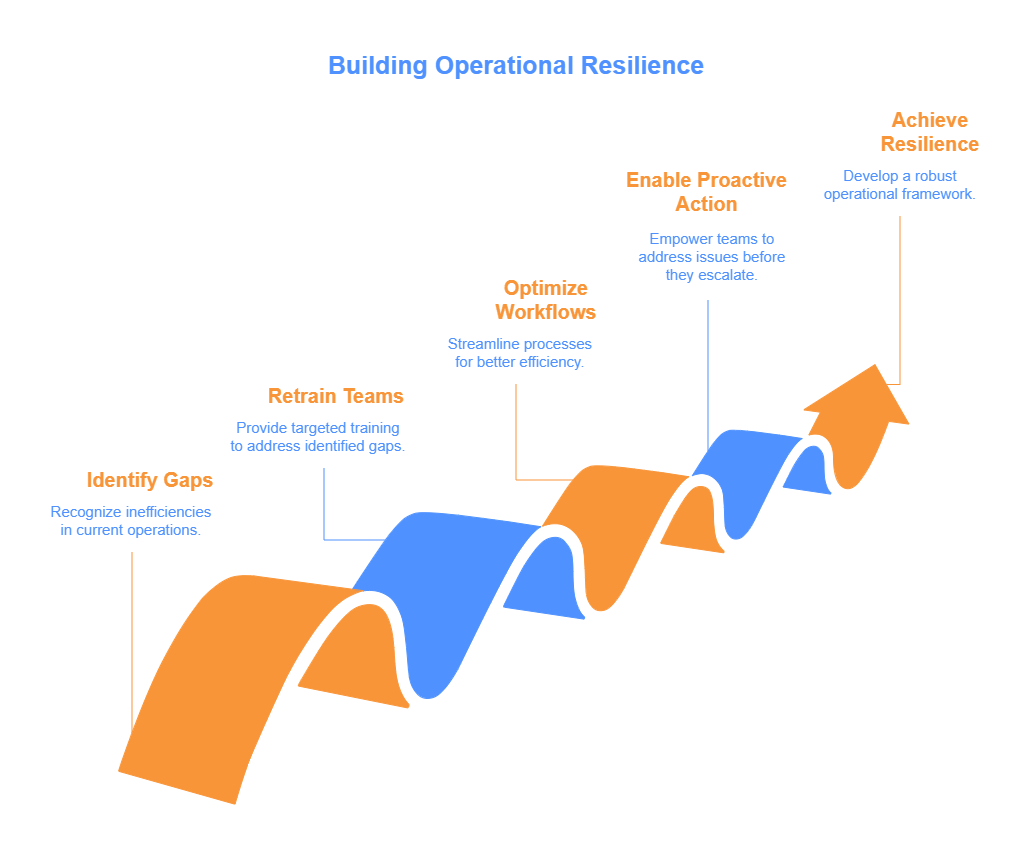
Our training programs streamline workflows and retrain personnel with performance-first learning, improving day-to-day efficiency and operational reliability. With OMS, downtime becomes the exception, not the rule.

In fact, can the Energy Industry Prevent Downtime with Better Training?
At OMS, the answer is a resounding yes. By equipping teams with the right skills and strategies, organizations can shift from reactive problem-solving to proactive performance, protecting their operations against costly interruptions.
Why Offsite Operations Are Still Overlooked in Refineries

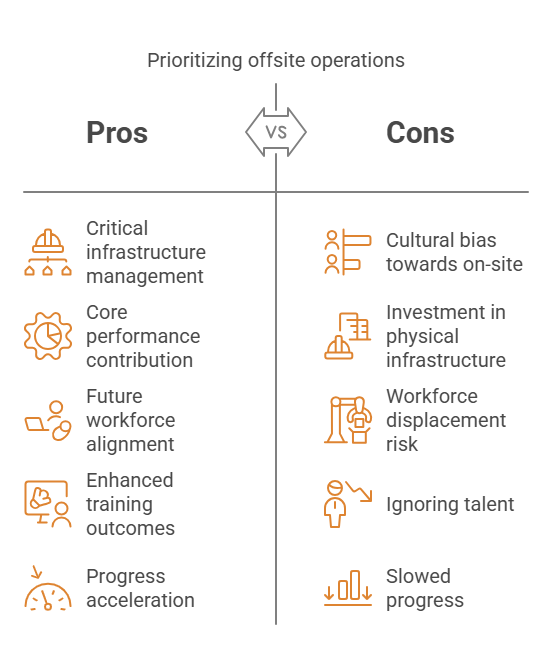
Why Offsite Still Gets Ignored Despite their importance, offsite operations often exist in the shadows of larger refinery priorities. There’s still a strong bias toward traditional, on-site operations. This cultural mindset makes remote work and virtual learning seem less valuable, even when the data says otherwise. According to EY, up to 30% of the oil and gas workforce could be displaced by 2040 due to the impact of automation and digitization. Yet many companies continue to invest more in physical infrastructure than in people, especially off-site personnel. Offsite teams manage critical infrastructure and contribute to core performance metrics. Ignoring them not only overlooks talent, but it also slows progress.

At OMS, we shine a light on these blind spots. Our platform validates and elevates off-site roles by aligning training outcomes with operational key performance indicators (KPIs). We help shift mindsets from outdated views to a forward-looking approach that sees off-site training as essential, not optional.
How Offsite Operations Training Can Prevent Safety Risks

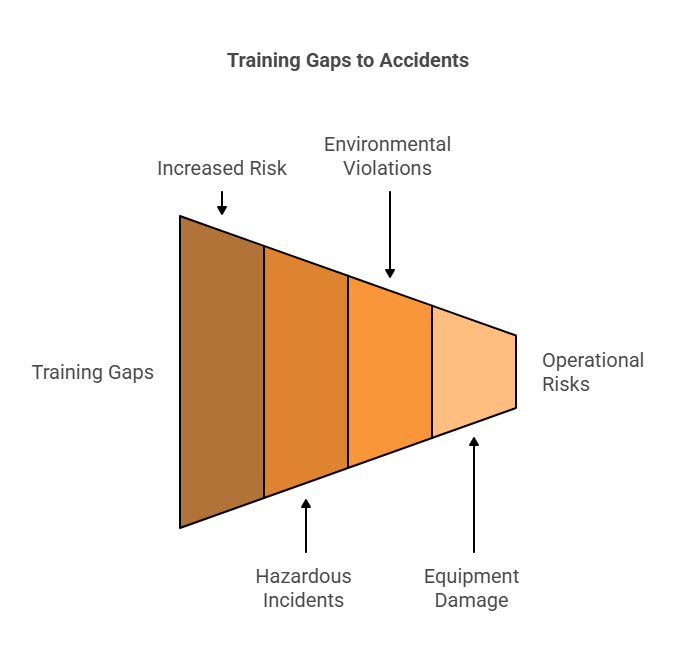
Training as Risk Prevention: Workplace Safety Starts with Training—and When Offsite Teams Don’t Receive Continuous, High-Quality Education, the Whole Operation Is at Risk. A small error during tank gauging or steam trap monitoring can quickly lead to hazardous incidents, environmental violations, or equipment damage. OSHA links 40% of industrial accidents to training gaps, and in refining, those gaps are often preventable. The American Petroleum Institute (API) emphasizes the importance of structured training for inspections, equipment handling, and auditing. Yet, many refineries still fall short on recurring training for off-site teams.

OMS turns safety into a proactive practice. Through mobile-first, role-specific modules, we keep off-site workers engaged and prepared. Our platform helps operators build the confidence and expertise to prevent issues before they escalate into emergencies.
Remote Work and the Rise of Digital Offsite Operations

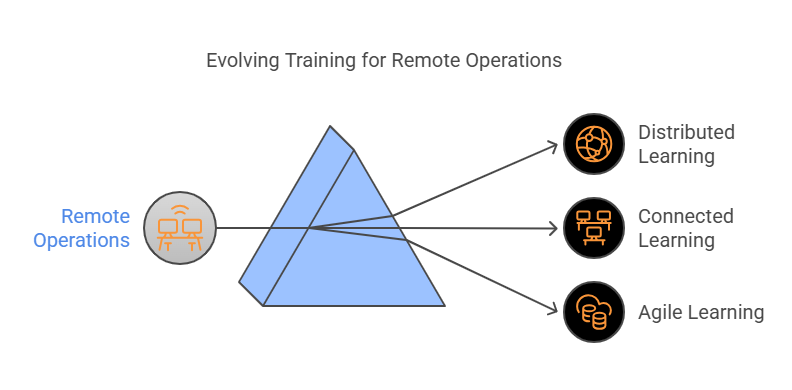
Remote is the New Core. Remote Operations Centers (ROCs) have redefined off-site work. Today, critical functions such as monitoring, adjustments, and inspections are often conducted digitally, sometimes from thousands of miles away. Norway’s Remota, for example, uses ROCs to control offshore ROVs and conduct inspections from shore. This shift demands a parallel evolution in training. Relying on occasional, centralized training sessions no longer aligns with the way work is done. Learning must be as distributed, connected, and agile as the teams it supports.

That’s why OMS acts as a refinery’s remote learning center. We deliver centralized training to decentralized teams, offer predictive upskilling, and make learning measurable and effective. With our platform, offsite operations aren’t isolated—they’re empowered, aligned, and always up to speed.
offsite operations

Learning Velocity: The New KPI for Offsite Operations Excellence

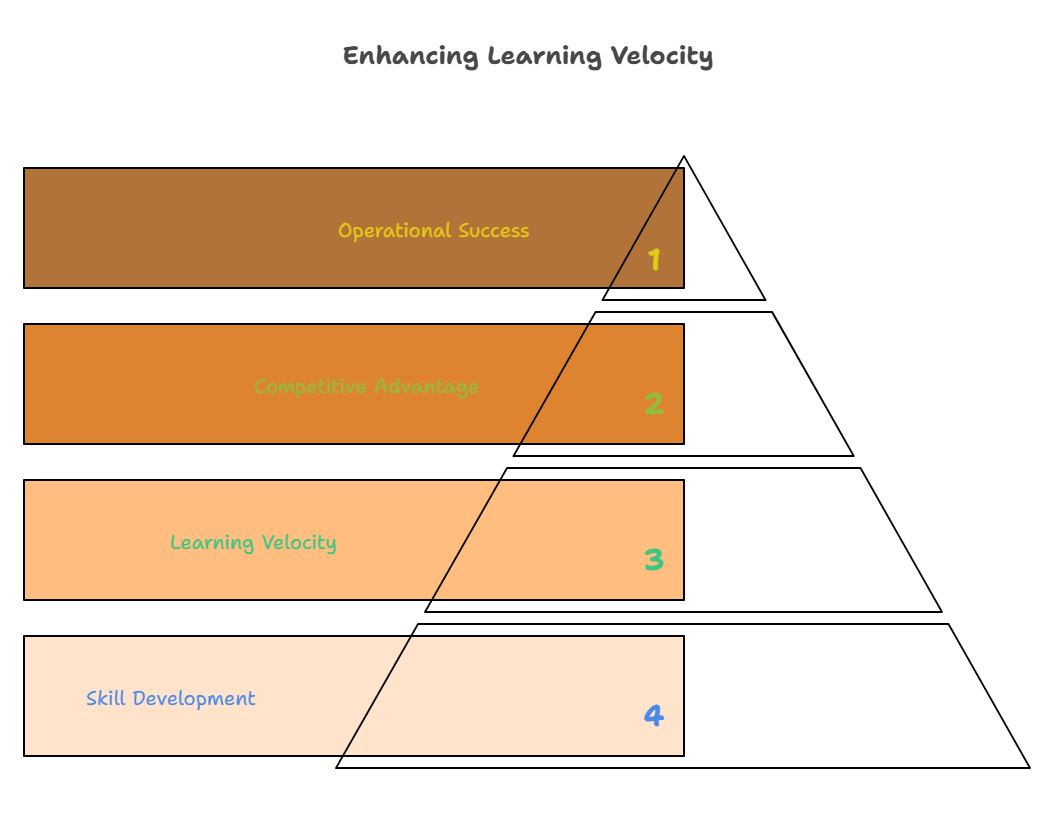
Your New Operational KPI In a fast-changing environment, the speed at which employees can learn and adapt is as important as what they know. That’s where the concept of “learning velocity” comes in. It’s a measure of how quickly a workforce can acquire and apply new skills to real-time challenges. McKinsey notes that companies prioritizing skill development, especially in cognitive, emotional, and problem-solving areas, are more resilient and adaptive. And in refining, where digital systems, automation, and AI are proliferating, earning impacts velocity directly translates to a competitive advantage.

OMS boosts learning velocity by tailoring education to individual roles, offering modular lessons, and ensuring knowledge sticks through real-world simulations. With us, training doesn’t just keep up—it stays ahead of the curve and delivers bottom-line results.
refinery offsite operations

Measuring the Training Impact on Offsite Operations

Let’s talk about real results. Carlos, a blending operator in Colombia, used to struggle with high blend giveaway every day. After taking just one OMS optimization course, his performance improved quickly, and giveaway dropped by 15% in just a few weeks. That’s real impact, fast. And Carlos isn’t the only success story. Across OMS clients, onboarding times have been reduced from 10 weeks to 4, blend variability has decreased by 18% in just three months, and teams report feeling more confident in their roles.
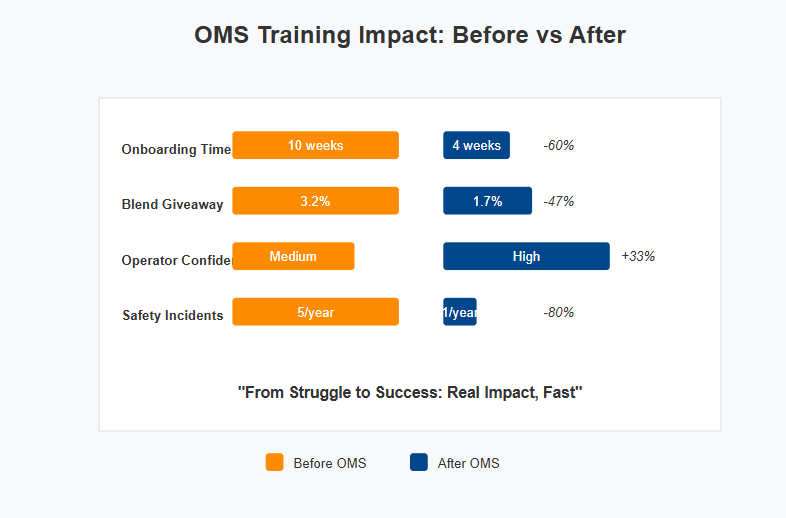
OMS training turns stories like Carlos’s into standard outcomes. Our platform delivers consistent, measurable improvements across operations, reducing cost, enhancing safety, and boosting morale.

Why Training Is the Infrastructure for Scalable Offsite Operations

The Backbone of Transformation Training is often viewed as overhead, but in reality, it’s operational infrastructure. Companies that prioritize continuous learning consistently outperform their peers in terms of adaptability, compliance, and digital maturity. According to Bain’s Energy Transformation Roadmap, companies that embed learning into operations respond to disruptions three times faster. BCG’s Digital Operating Model series confirms that workforce development is central to achieving digital maturity.

OMS builds that infrastructure. Our training ecosystem supports refinery success through strategic, role-based education that scales with your needs. From foundational knowledge to advanced analytics, we integrate learning directly into your daily operations, enabling seamless integration of learning into your daily workflow.

Modernizing Offsite Operations Training for the Future of Refining

Let’s face it—yesterday’s training models can’t keep up with today’s high-tech, high-stakes refinery environments. If teams don’t have timely, flexible access to learning, performance, and safety, they suffer. Paper manuals and annual refreshers aren’t enough.

OMS modernizes refinery training with intelligent, on-demand learning that integrates seamlessly into daily operations. Our mobile-accessible, role-specific programs adapt to your workforce’s needs and your evolving processes. Learning becomes a continuous advantage, not a disruption.

Benchmarking Learning Maturity in Offsite Operations

CapabilityTraditional RefineriesDigital LeadersOMS Advantage
Training DeliveryIn-person, annualOnline, continuousModular, on-demand
Skills TrackingSpreadsheetsDashboardsIntegrated analytics
Offsite TrainingMinimalBusiness-alignedROI-measured

OMS bridges the gap, making training a strategic driver of operational excellence.

Driving ESG & Compliance Through Offsite Operations Learning

Our digital platform supports your broader sustainability and compliance goals by:

  • Reducing emissions through paperless, virtual training
  • Offering safety courses aligned with ISO/API standards
  • Providing multilingual content for greater accessibility

Leadership Check-In: Ask Yourself

  • Are operators getting training exactly when and where they need it?
  • How closely does your training align with performance KPIs?
  • Are you tracking how quickly your teams are upskilled?

Why Offsite Operations Deserve More Strategic Focus

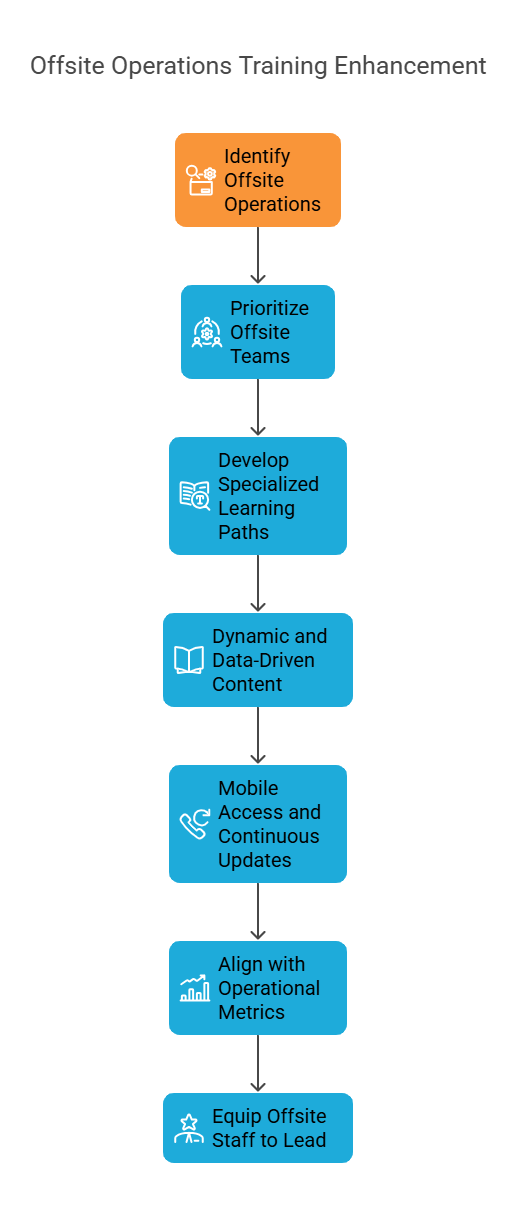
In most refineries, offsite operations—blending, logistics, utilities, storage—don’t receive the same training focus as core process units. OMS changes that.

We prioritize off-site teams with specialized learning paths tailored to their roles and challenges. Our content is dynamic, data-driven, and designed to build both competence and confidence in the field.

Through mobile access, continuous updates, and alignment with key operational metrics, offsite staff are not only included—they’re equipped to lead.
Conclusion: Offsite Operations Are Essential, Not Optional

Offsite operations are no longer the silent support act; they are central to the performance, safety, and agility of modern refineries. As the industry evolves, so must the approach to training these critical teams. Ignoring off-site operations is not just a missed opportunity; it’s a strategic vulnerability. By embracing role-specific, scalable, and digital-first learning solutions, organizations can unlock untapped potential, reduce downtime, and build a future-ready workforce. OMS eLearning Academy empowers refineries to turn training into a competitive advantage, making offsite excellence not only achievable but also essential. It is time to recognize that off-site operations aren’t optional; they are foundational.

Request a customized demo at
🔗 https://www.oms-elearning-academy.com/

refinery Myths

Introduction – Why Refinery Safety Deserves a Reality Check

Refinery operations in the oil and gas industry are inherently high-risk, where even minor errors can lead to catastrophic outcomes. Despite regulatory compliance efforts, serious incidents persist, highlighting the need for a deeper safety overhaul.

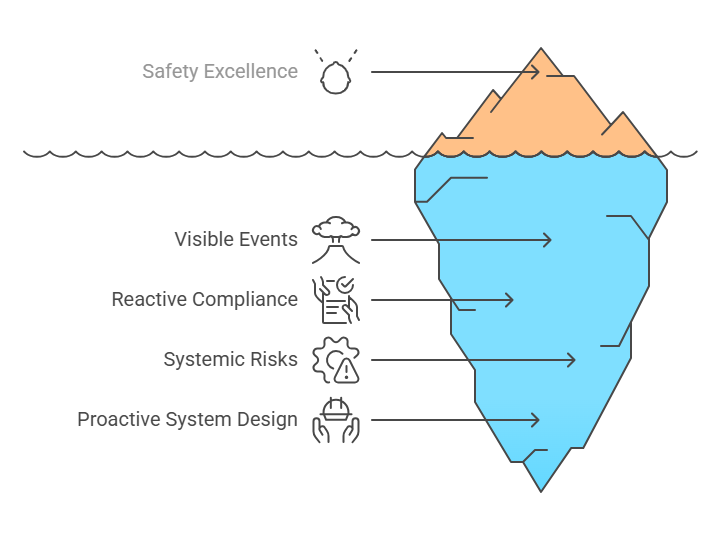
The 2005 BP Texas City explosion, which killed 15 people, occurred despite OSHA compliance, exposing systemic failures in operational practices—a pattern echoed in the 2012 Chevron Richmond fire, where corrosion and leadership breakdowns contributed to the disaster Chemical Safety Board (CSB). According to the U.S. Chemical Safety Board, over 50% of refinery incidents stem from systemic—not frontline—failures, including poor maintenance, miscommunication, and weak safety architectures.

Global losses from such incidents amount to billions annually, making it imperative to embrace structured Process Safety Management (PSM), as outlined by the American Petroleum Institute (API)

This sets the stage for dispelling persistent safety myths in refining, each rooted in outdated assumptions that need urgent revisiting.

Myth #1 – “Compliance Equals Safety”

Why It’s a Myth

One of the most persistent misconceptions is equating compliance with safety excellence. The National Safety Council (NSC) notes that compliance is reactive and ensures only minimal legal standards, not operational robustness.

BP Texas City was OSHA-compliant at its explosion, yet systemic lapses in hazard recognition and procedural enforcement led to catastrophe. The Energy Institute (UK) reinforces this with case studies of compliant facilities that failed catastrophically.

The Reality

True safety comes from proactive system design. As McKinsey detailed, high-reliability organizations integrate real-time analytics, continuous improvement, and predictive frameworks well beyond regulation.

The Center for Chemical Process Safety (CCPS) advocates risk-based approaches, in which leading indicators, cross-functional safety audits, and culture-building are integrated.

See Myth #1 in our refinery safety framework to explore how compliance-only approaches fail in dynamic environments.

Myth #2 – “Incidents Only Happen Due to Human Error”

Why It’s a Myth

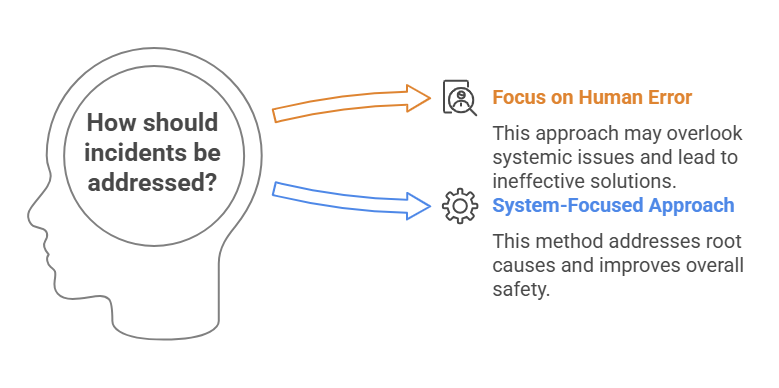
Blaming frontline staff for incidents ignores broader systemic realities. According to NIOSH, human error is more often a symptom of poor system design than individual failure.

The Human Factors and Ergonomics Society (HFES) supports this, noting that 80–90% of errors stem from unclear expectations, poor interface design, fatigue, or inadequate training.

The Reality

Safety stems from an organization’s ability to learn from and adapt to failure. In Harvard Business Review, system-based approaches are shown to outperform blame-focused models.

Sidney Dekker’s Field Guide to Understanding Human Error reframes errors as system-induced, highlighting the need for design thinking and operational empathy.

Take the Bhopal disaster: far from a single-point failure, it revealed widespread breakdowns in maintenance, training, and monitoring protocols—the same themes repeated in modern refinery incidents.

Read Myth #2 from our framework for a deeper dive into how systems thinking transforms safety culture.

Myth #3 – “More Alarms Mean More Safety”

Why It’s a Myth

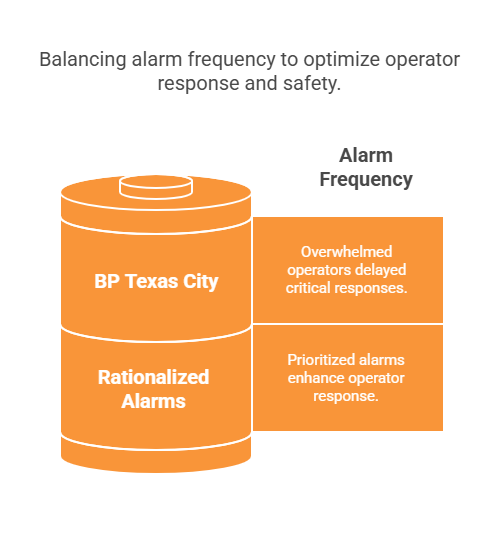
Alarms are a safety staple, but quantity can overwhelm rather than assist. The ISA 18.2 Alarm Management Standard warns against “alarm floods” that desensitize operators and delay critical responses.

During the BP Texas City explosion, 200+ alarms were triggered within minutes, overwhelming operators with noise and chaos. OSHA correlates this to cognitive overload, rendering even well-trained staff ineffective during crises.

The Reality

Alarm systems should be intelligent, filtered, and prioritized. Honeywell advocates for alarm rationalization strategies, while the ARC Advisory Group emphasizes tiered alarms and dynamic suppression during transitional phases.

For complete analysis, revisit Myth #3 on the risks of unchecked alarm saturation.

Myth #4 – “Experienced Operators Don’t Need Ongoing Safety Training”

Why It’s a Myth

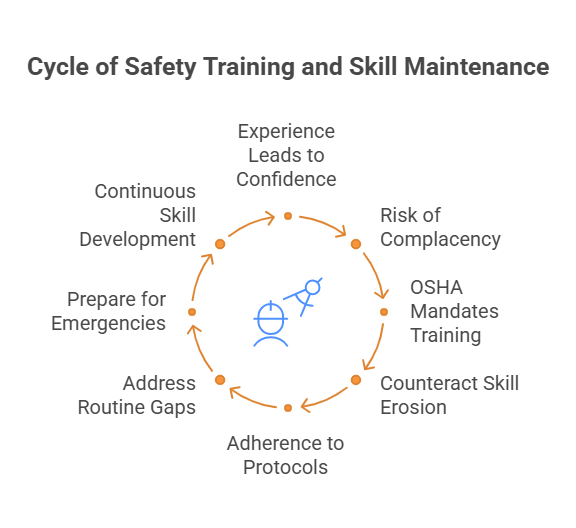
Experience brings confidence, but also procedural shortcuts and drift. OSHA mandates ongoing refresher training to combat complacency and skill erosion.

The CCPS shows that over 60% of experienced operators routinely skip steps unless retrained. Habituation to routine tasks often leads to gaps in protocol during non-routine or emergency events.

The Reality

Modern training is scenario-based and simulation-driven. Energy Safety Canada has led the shift toward immersive platforms that simulate real-world failure modes for both new and senior teams.

OMS Academy supports this evolution with refinery-specific eLearning platforms combining role-based simulation, procedural requalification, and failure-mode training, ensuring teams are prepared rather than experienced.

Dive deeper into Myth #4 for insights on how even veterans need training evolution.

Myth #5 – “Digital Tools Make Plants Less Safe

Why It’s a Myth

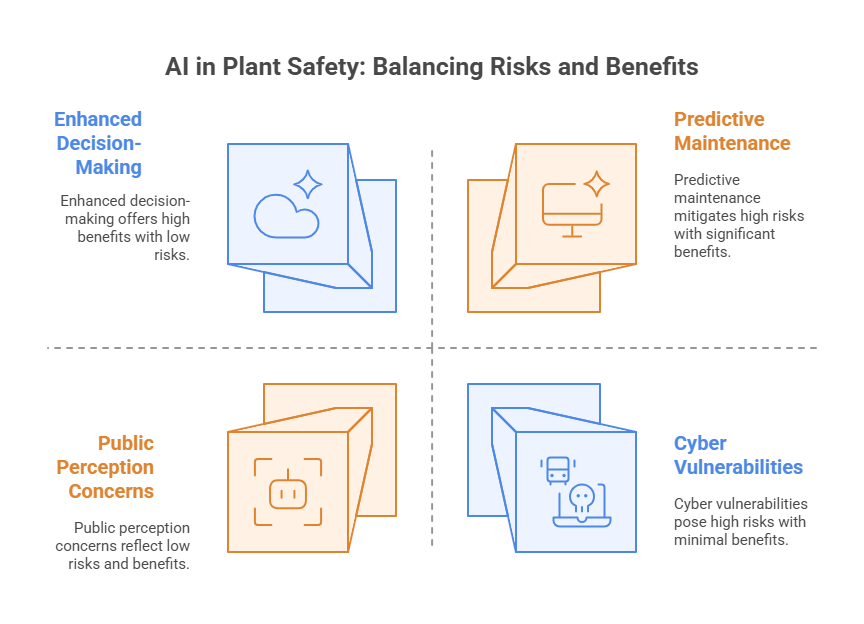
As AI and automation spread across refining, some fear a loss of human control and increased cyber risk. CISA warns of growing digital vulnerabilities, while public perception remains wary of black-box algorithms.

However, Harvard Business Review debunks the notion that digital means disengagement. Properly deployed, AI frees operators from repetitive tasks and enhances decision clarity.

The Reality

AI isn’t replacing operators—it’s augmenting safety. GE Digital’s APM uses predictive maintenance to detect faults days in advance, reducing downtime and incident likelihood.

OMS Solutions integrates diagnostic AI in movement automation, reconciliation, and blending. In one documented case, AI detected abnormal vibration in a pump, averting a $250K shutdown.

Explore Myth #5 to see how digital transformation strengthens refinery safety.

Conclusion – Safety Is a Living System, Not a Static Score

Safety isn’t static in chemical engineering and oil refining—it’s systemic. As aging assets, digital disruption, and workforce transition reshape the industry, the key to resilience lies in adaptive learning, reflective teams, and continuous challenge of outdated assumptions.

The Lean Enterprise Institute promotes daily problem-solving routines that keep safety dynamic. Harvard Business Review encourages organizational adaptability through improvisational leadership and feedback-rich environments.

For refinery leaders, the next step isn’t just more technology—it’s more clarity, culture, and capability. Resources like OMS Academy offer a digital-first path to building competency across the operator lifecycle.

In today’s complex and high-risk refinery landscape, upskilling isn’t a nice-to-have—it’s a strategic must. This article explores the hidden financial risks of ignoring workforce development and shows how smart training investments can protect margins, boost resilience, and future-proof assets. From operational errors to compliance penalties, the costs add up quickly. So, the real question is: can your refinery afford not to invest in its people?

Upskilling to Prevent Hidden Financial Leaks in Refineries

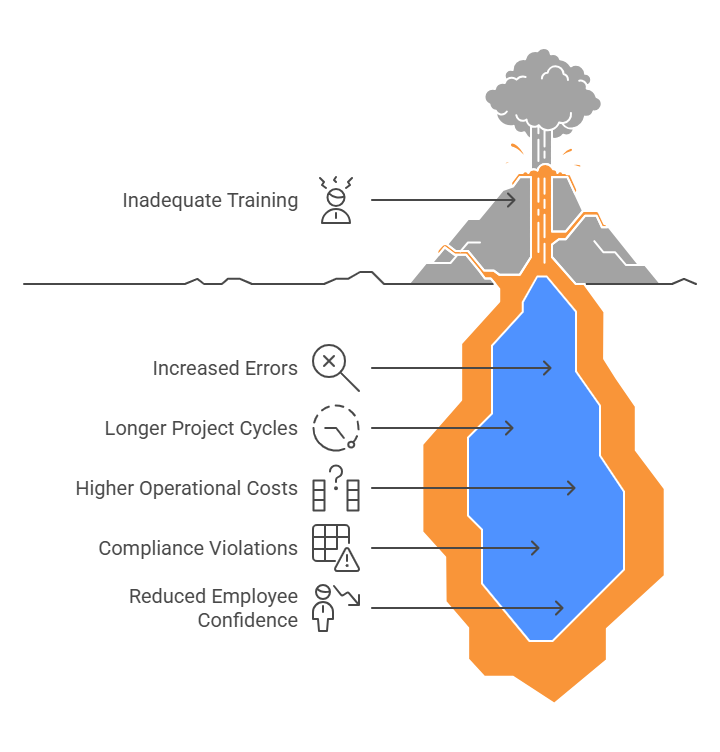
Inadequate training directly leads to increased errors, rework, and operational inefficiencies, all of which carry serious financial consequences. Not properly trained employees are more likely to make mistakes, slow down workflows, and require constant corrective actions. Over time, these issues drive operational costs through wasted materials, extended project timelines, and poor-quality outputs. Additionally, frequent errors can cause customer dissatisfaction, compliance failures, and even damage to high-value assets. Rather than being a minor inconvenience, the cumulative impact of poor training quietly drains profitability, making it a hidden but critical threat to the organization’s long-term success.

How Upskilling Reduces Costly Errors and Operational Inefficiencies

  • Increased error rates leading to product quality issues and costly rework.
  • Longer project cycles are due to slower task execution and corrections.
  • Higher operational costs from wasted resources and repeated efforts.
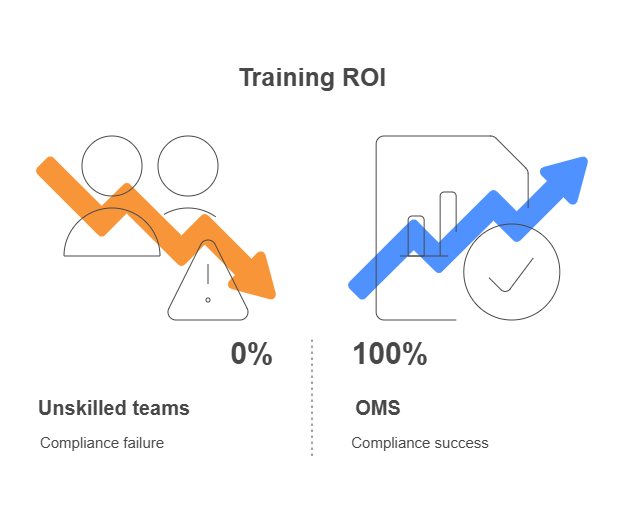
  • Greater risk of compliance violations, fines, and legal exposure.
  • Reduced employee confidence and engagement are further hurting performance.

OMS quantifies avoidable losses by modeling cost-per-error scenarios, comparing trained vs. untrained teams, and projecting long-term savings from targeted upskilling investments.

Upskilling for Sustainable Productivity and Profitability Gains

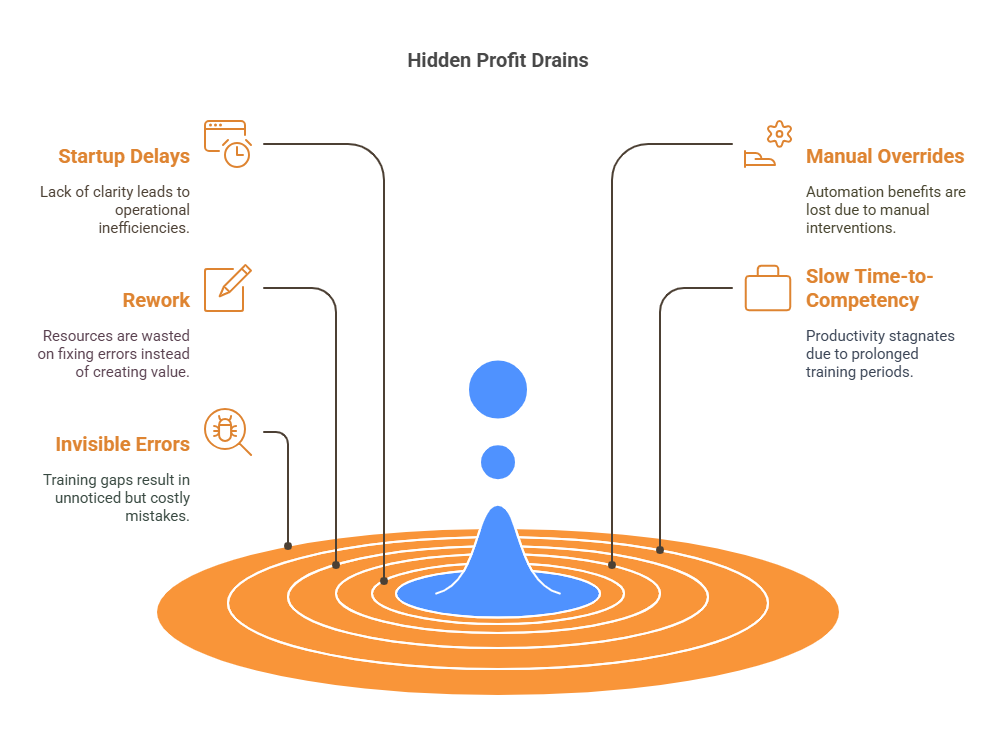
Beyond the immediate costs of operational errors, inadequate training leads to pervasive but less visible drains on productivity. Research from eLearning Industry highlights that companies with undertrained workforces experience prolonged downtimes, higher rates of rework, and sluggish operational cycles—all severely impacting profitability.

Upskilling to Reduce Downtime, Rework, and Manual Overrides

  • Extended Downtime During Startups and Shutdowns: A Poor understanding of procedures lengthens critical transitions.
  • Higher Frequency of Manual Overrides: Undermining automated systems and introducing human error risks.
  • Increased Rework Cycles: Due to incorrect first-time execution of critical tasks.

These “invisible” losses erode margins quietly but relentlessly, compromising financial results and operational stability.

OMS tracks time-to-competency by measuring faster startups, fewer manual overrides, and improved first-pass rates, directly linking training to productivity and profitability gains.

Upskilling as a Strategic Resilience Tool in Refinery Operations

In the high-cost oil and gas refining world, CFOs carefully check every physical investment for its return on investment (ROI) and risk. In the same way, workforce development should be treated with equal importance. After all, innovative training programs can bring real returns by strengthening operations, helping get more out of assets, and protecting profits, just like significant equipment investments.

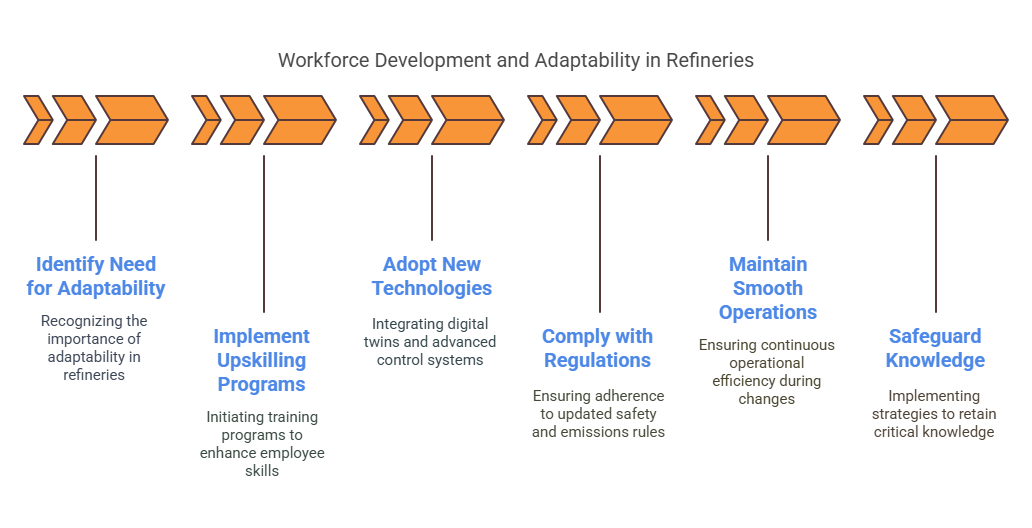
Today, refineries face fast-changing technology, market ups and downs, and new regulations. Because of this, employees who can quickly adapt to new tools, systems, and rules are key to keeping the business strong. According to research from Valamis, focused upskilling programs help companies react faster and handle outside pressures better, which helps protect their revenue.

So, how prepared is your workforce to keep pace with change?

How Upskilling Enables Faster Tech Adoption and Compliance

  • Fast Adoption of New Technologies: Digital twins and advanced control systems.
  • Quick Compliance with New Regulations: Like updated safety and emissions rules.
  • Keeping Operations Running Smoothly: Even during workforce changes or market shifts.

OMS safeguards knowledge with scenario-based training, regular proficiency assessments, and targeted retention of critical roles to ensure operational resilience and sustained performance.

Upskilling to Maximize Asset Performance and Equipment Lifespan

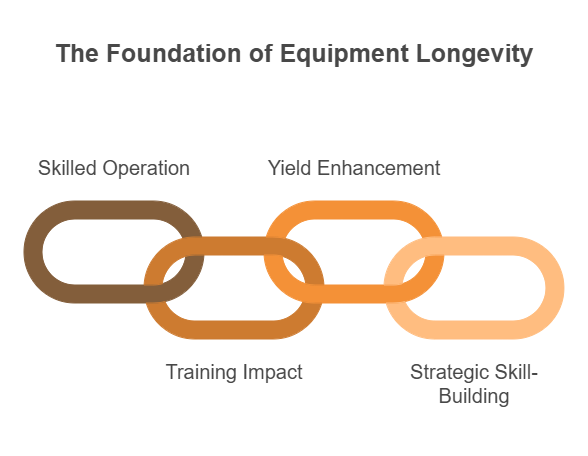
In a refinery, even the most advanced equipment—like turbines, distillation units, and tank systems—is only as good as those operating it. Employees who aren’t adequately trained can easily underuse or damage these high-value assets, leading to lower efficiency, faster wear and tear, and expensive downtime. Research from the Training Industry shows that investing in employee skills is key to getting the best performance from your equipment.

So, are you giving your team the tools to protect and maximize your most valuable assets?

Linking Upskilling to Asset Strategy and ROI

  • Extended Equipment Lifespan: Through proper operation and preventive maintenance.
  • Enhanced Process Yields: By optimizing production settings and minimizing variability.
  • Safer Operations: Reducing wear-and-tear and avoiding catastrophic failures.

OMS integrates training with asset strategy by focusing on critical systems, high-ROI equipment, and maintenance best practices. This ensures teams maximize upgrades and performance while turning workforce development into a key operational and financial value driver.

Upskilling to Avoid Financial Risks and Regulatory Penalties

In refinery operations, the absence of a strategic training agenda erodes efficiency and exposes the organization to severe financial and legal risks. Compliance violations, workforce turnover, and escalating replacement costs are the “silent killers” of profitability that companies can no longer afford to ignore.

Failure to adhere to stringent safety and environmental regulations has steep financial consequences. Regulatory bodies like OSHA, EPA, and state agencies impose fines that can reach millions of dollars for non-compliance, not to mention the reputational damage and operational shutdowns triggered by serious infractions.

Inadequate training is a root cause of many compliance breaches, resulting in:

  • Safety Violations: Mishandling hazardous materials, unsafe operational practices.
  • Environmental Infractions: Non-compliance with emissions standards or spill containment protocols.
  • Audit Failures: Gaps in documentation, reporting, and procedural adherence.

Each incident incurs direct fines, often increasing insurance premiums, legal settlements, and costly downtime.

OMS embeds compliance into daily operations with refresher modules, audit-ready training, and scenario drills—minimizing risk and ensuring smooth, regulation-ready refinery performance.

Using Upskilling to Reduce Turnover and Retention Costs

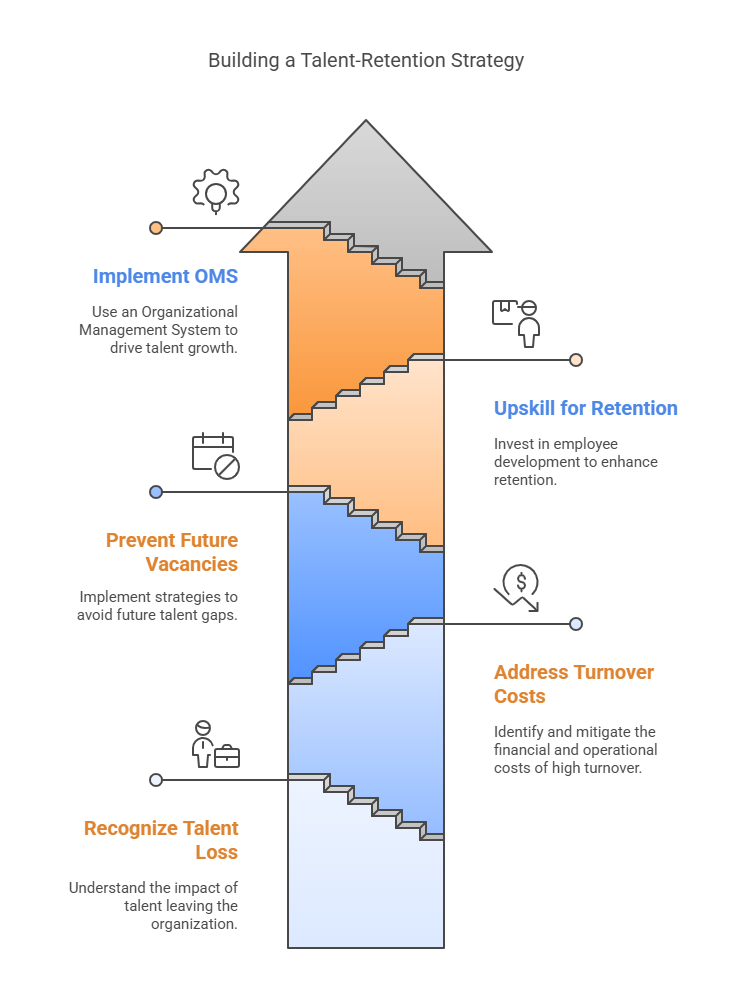
A less visible but equally dangerous cost of neglecting training is the impact on employee retention. Research shows that a lack of career development opportunities is one of the primary drivers of voluntary turnover, and replacing skilled refinery workers can cost 100% to 150% of their annual salary.

The operational consequences of turnover include:

  • Loss of Institutional Knowledge: Eroding decades of operational insight.
  • Reduced Operational Efficiency: Increased error rates and downtime during onboarding phases.
  • Higher Recruitment and Training Expenses: Prolonged vacancies and retraining new hires.

OMS tackles retention by creating a culture of growth and engagement. It offers clear role growth pathways, skill recognition programs to validate expertise, and training that builds confidence through mastery. This approach boosts employee engagement, preserves critical skills, stabilizes operations, and cuts replacement costs.

Upskilling as a Predictable Investment, Not an Overhead Expense

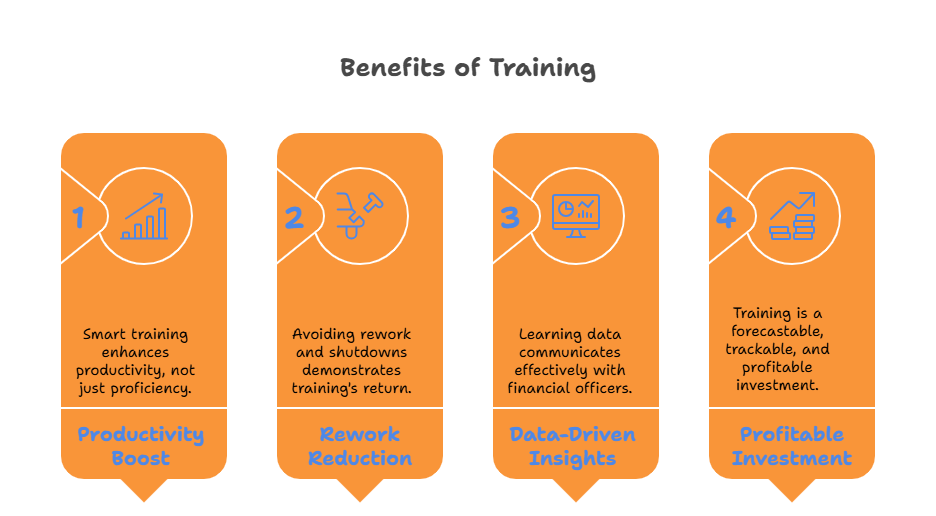
Many organizations still mistakenly classify training as an operational overhead rather than recognizing it as a strategic investment with predictable, measurable returns. In the manufacturing and refining sectors, where operational efficiency, regulatory compliance, and agility are critical, properly structured training programs have a direct and quantifiable impact on business performance.

Calculating ROI from Upskilling: Methods That Matter

When approached strategically, training costs can be forecasted with high accuracy and tied directly to measurable outcomes. Research from SHRM indicates that organizations investing effectively in employee development experience significantly improved profitability and productivity.

Key methodologies for calculating training ROI include:

  • Productivity Gains: Measuring output improvements post-training.
  • Error and Rework Reduction: Quantifying cost savings from fewer operational mistakes.
  • Downtime Avoidance: Tracking reductions in unplanned shutdowns or slowdowns.
  • Margin Improvements: Monitoring enhancements in yield and throughput efficiency.

OMS makes it easy to measure training impact with CFO-friendly dashboards, real-time tracking against operational KPIs like downtime and margin per barrel, and customizable reports by asset, department, or skill. By turning learning data into clear financial insights, OMS ensures training investments are managed as carefully as any major capital project.

Upskilling Drives Agility in Uncertain Markets

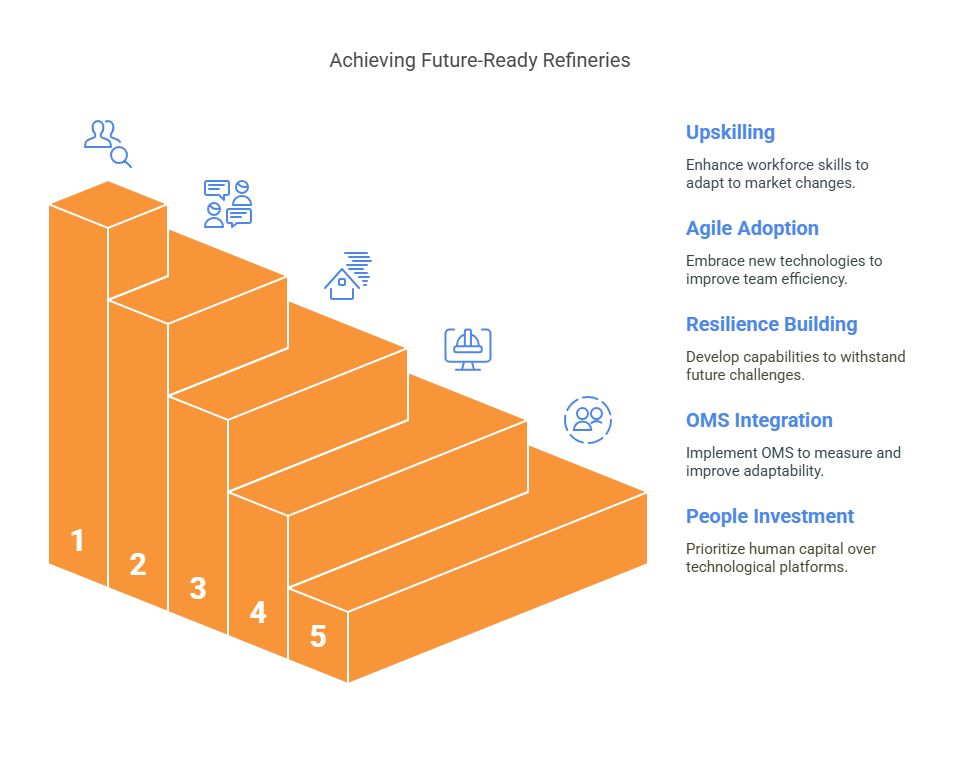
The refining sector faces an unprecedented pace of change—from shifting energy markets and regulatory reforms to technological disruptions. Organizations that can adapt rapidly not only survive but thrive. Upskilling enables employees to respond effectively to new challenges and seize emerging opportunities.

According to the World Economic Forum, companies prioritizing upskilling develop a resilient, future-ready workforce capable of navigating market volatility and evolving customer expectations.

How Upskilling Equips Teams for Change and Innovation

  • Faster Adoption of New Technologies: Advanced analytics, predictive maintenance tools, and digital operations platforms.
  • Enhanced Responsiveness to Market Dynamics: Quick realignment of production strategies or process parameters.
  • Stronger Competitive Positioning: Ability to deliver higher value to customers faster than less agile competitors.

OMS drives organizational agility with its “Readiness to Change” framework, which uses baseline assessments to gauge adaptability, microlearning sprints to quickly build targeted skills, and change readiness metrics to track progress. This proactive approach helps refineries pivot fast—whether facing new technologies, regulations, or market shifts—without missing a beat.

Upskilling Is the Business Case—Not Just a Budget Line

Strategic training is not a perk—it is a fundamental business driver. Companies can achieve substantial long-term value by linking training investments to operational resilience, compliance assurance, asset optimization, and workforce agility.

Final OMS Integration

OMS transforms traditional training approaches into high-impact, CFO-friendly performance initiatives by:

  • Making Learning Measurable: Every training dollar is linked to tangible business outcomes.
  • Designing Modular Programs: Allowing flexible, targeted development pathways based on operational priorities.
  • Turning Cost Centers into Value Generators: Repositioning workforce development as a core pillar of margin protection and competitive advantage.

Strategic upskilling is not optional but mission-critical in the high-stakes oil and gas refining world. Organizations recognizing and acting on this reality will be best positioned to lead the industry into a more resilient, agile, and profitable future.

Even minor blending inaccuracies can affect production timelines, product quality, and overall efficiency in the complex environment of oil and gas refineries. These issues may lead to reblending, product giveaways, or non-compliance penalties, resulting in significant operational costs. What strategies can help improve blending accuracy in such conditions? This article outlines common challenges in refinery blending and examines how hybrid systems—particularly those that incorporate artificial intelligence (AI) and predictive modeling—are being used to enhance accuracy and support more reliable outcomes.

Blending Errors from Incorrect Component Ratio Predictions

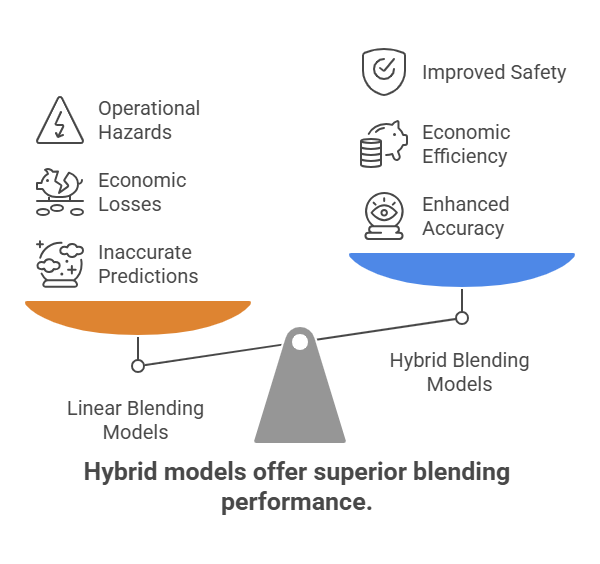
Blending crude and refined products involves nonlinear behavior. Traditional blending models frequently rely on linear assumptions, which often do not reflect actual process dynamics. Though commonly used, linear programming (LP) or rule-based models are limited in handling complex interactions within multi-component blends. 

  • AspenTech has reported that such limitations can lead to a 3–5% blend giveaway due to inaccurate ratio estimations. Furthermore, inaccurate blend ratio predictions can present process safety risks. 
  • According to the American Institute of Chemical Engineers’ Center for Chemical Process Safety (AIChE CCPS), deviations from expected blend compositions may elevate the likelihood of operational hazards, including high-pressure incidents and off-specification products.
  • To address these issues, hybrid models that combine LP with first-principles and machine learning (FPBM) methodologies are increasingly being implemented. 
  • Offsite Management Systems (OMS) has documented that FPBM-AI models offer over a 15% improvement in predictive accuracy over LP-only systems, enhancing reliability and reducing product giveaways.

Blending Errors Due to Inadequate Analyzer Coverage or Failure

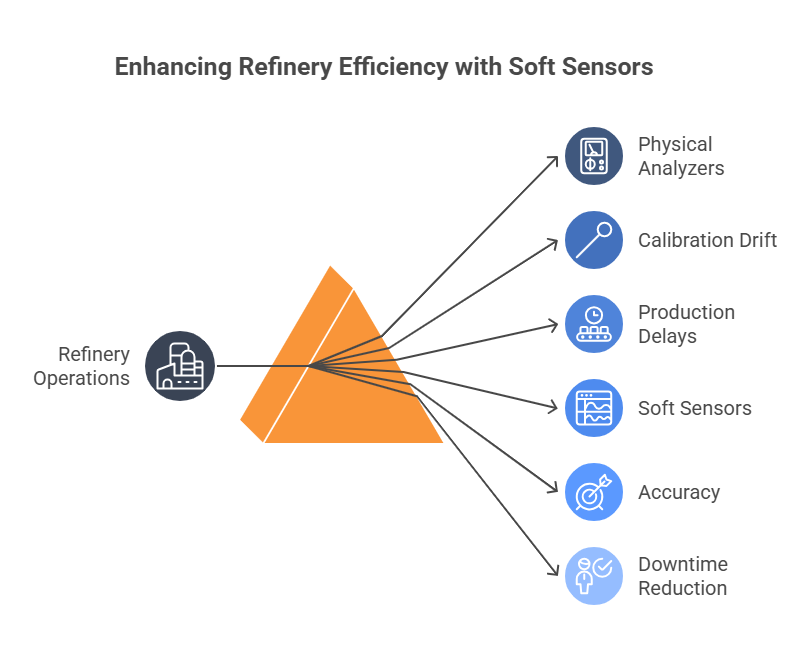
Physical analyzers, such as those developed by Honeywell and Emerson, are critical to ensuring that blends meet required specifications for parameters such as sulfur content, octane number, and viscosity. However, analyzers can malfunction or drift out of calibration over time, particularly under prolonged use or harsh environmental conditions. Such failures can delay blend approvals by one to four hours, with estimated losses exceeding $10,000 per hour due to production hold-ups.

  • Many refineries have adopted soft sensors—virtual analyzers trained using historical and real-time operational data to address these vulnerabilities.
  • These virtual systems can provide near-real-time estimates for critical properties with a typical accuracy of ±0.1%.
  • OMS has incorporated these sensors into its blend monitoring systems, reducing dependency on physical analyzers and minimizing associated downtime.

Blending Errors from Poor Blend Header Line-Up and Switching

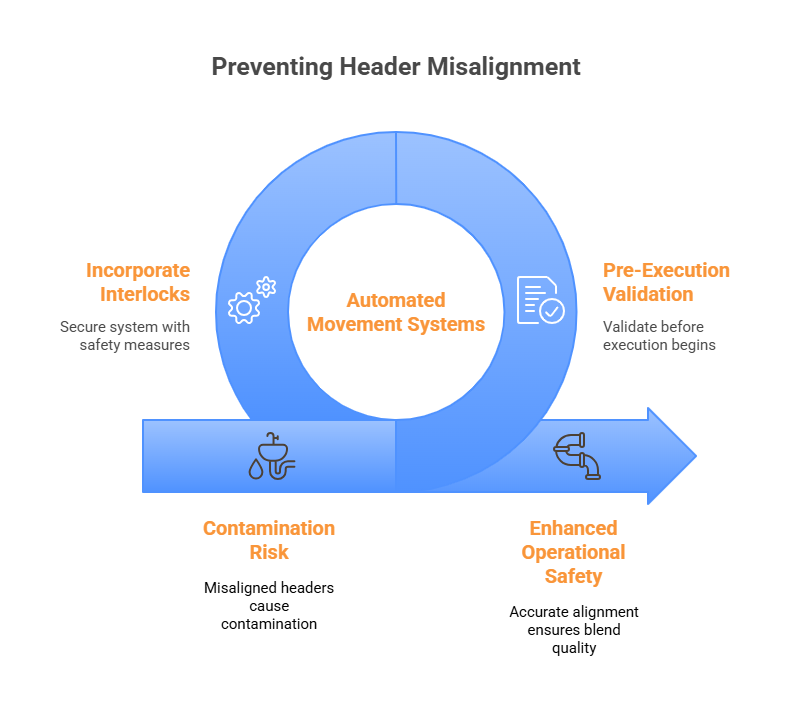
Properly aligning and sequencing the blend headers is key to maintaining product quality. A mistake in the header line-up or switching process can cause cross-contamination, sometimes severe enough to require reprocessing or discarding entire batches. That’s why industry standards, like those from the International Society of Automation (ISA), stress the need for strong control systems to help prevent these kinds of errors.

  • The ARC Advisory Group has reported that a single header contamination incident can result in the loss of 1,000–5,000 barrels, depending on the product, and can significantly impact downstream operations.
  • OMS’s automated movement systems include pre-execution validation and interlocks, which help ensure correct header configurations, reduce the potential for errors, and enhance operational safety.

Blending Errors Linked to Tank Heel Mismanagement

The residual product—the tank heel—remaining in tanks post-discharge can affect subsequent blends if not correctly managed. According to the American Petroleum Institute (API), failure to account for tank heel volumes can lead to blend quality deviations of up to 1%.

  • Emerson has observed that tank heel estimations are frequently based on static or outdated calculations that may not consider real-time variables such as temperature stratification or operator changes.
  • OMS integrates advanced heel modeling into its blend simulation and volume calculations, promoting accurate tracking and minimizing blend quality variability.

Blending Errors from Manual Adjustments Without Simulation

When performed without real-time simulation, manual interventions during blending can introduce significant operational risk. AVEVA notes that manual flow changes, if not verified through simulation, can result in blends falling outside specification limits.

  • Case studies from ControlGlobal illustrate instances where single manual overrides have led to blend failures, resulting in financial losses exceeding $150,000 per tank.
  • OMS offers online simulation tools that continuously assess blend predictions as operator inputs change. This allows for proactive risk management and reduced reliance on manual corrections.

Blending Errors from Scheduling Mismatch and Dispatch Interruptions

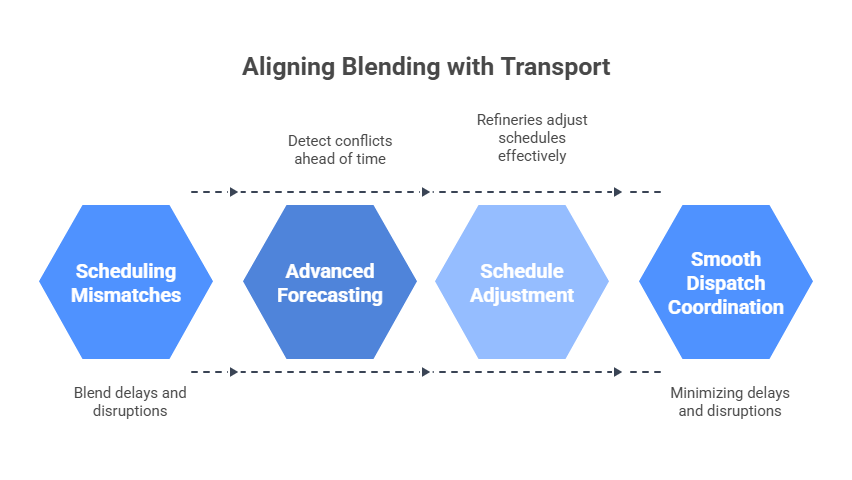
Coordinating blending activities with dispatch logistics is essential to maintaining refinery throughput. Misalignment between blend schedules and transport availability can result in inventory buildup, delayed deliveries, and customer dissatisfaction. ABB reports that even advanced model predictive control systems may struggle to align blend readiness with dispatch schedules.

  • According to a KBC survey, scheduling mismatches account for more than 25% of blend delays.
  • OMS addresses this with forecasting and simulation tools that identify and flag potential conflicts 6–12 hours in advance, allowing for timely adjustments and smoother dispatch coordination.

Conclusion: Smarter Blending Begins with Smarter Systems

As the refining sector faces increasing operational, environmental, and economic pressures, advanced AI/ML-based systems are becoming indispensable tools. McKinsey and other industry leaders have emphasized the growing importance of data-driven automation in maintaining competitiveness and safety.

Offsite Management Systems (OMS) exemplifies this industry shift with its integrated suite of solutions, which includes FPBM-based blend optimization, virtual sensor analytics, and predictive scheduling tools. Documented outcomes include:

  • $1.8 million per year in blend margin improvements at a Latin American refinery due to reduced reblends
  • $500,000 in capital expenditure savings through virtual analyzer implementation
  • 95% reduction in manual blend interventions within the first three months of deployment

These results underscore the value of transitioning from legacy systems to comprehensive, intelligent blending platforms. Rather than relying on incremental upgrades, the industry’s path forward lies in adopting robust, integrated technologies that enhance safety, accuracy, and operational efficiency.

The refining industry is at a turning point. Beyond the global energy transition, digital technologies offer tangible ways to improve efficiency, safety, and environmental performance. But fundamental transformation goes deeper than adopting new tools—it requires rethinking how refineries operate from the ground up. This blog provides a practical playbook for future-proofing refinery operations through innovative, scalable, and sustainable digital strategies. It focuses on actionable steps that deliver measurable results, not years from now, but starting today. Whether modernizing legacy systems or building new capabilities, the goal is clear: drive meaningful impact through thoughtful, technology-enabled operational change.

Step 1 – Set the Foundation for Refinery Digitalization

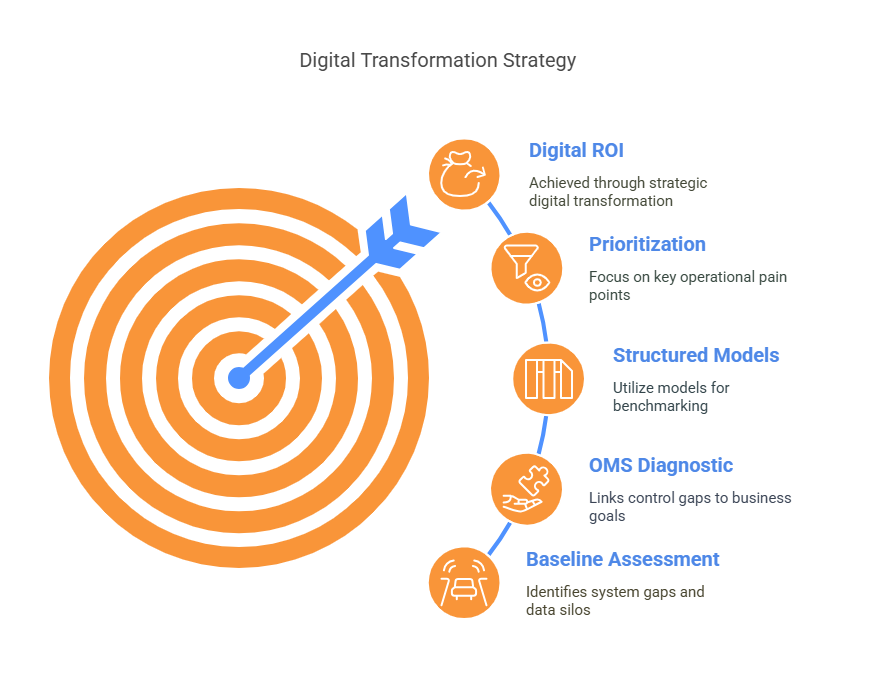
Conduct a Digital Readiness Assessment for Refinery Digitalization

Before starting any digital transformation, refineries need a clear picture of where they currently stand. And that means more than just listing the technologies they use. It requires a strategic map of existing systems—everything from control platforms and data historians to instrumentation and automation layers.

The reality? Many plants still depend on outdated, disconnected systems, which create data silos and make it hard to get a full view of performance. Understanding this baseline is the first—and most critical—step toward making smart, targeted improvements that move the needle.

Structured frameworks like AVEVA’s Digital Maturity Model can help assess readiness across automation depth, data integration, and decision support. But maturity isn’t just about systems—it’s also about people and processes. Input from operations, maintenance, planning, and IT teams often surfaces hidden challenges and missed opportunities that technical audits overlook.

OMS helps refineries take this crucial first step with a Digital Maturity Diagnostic built specifically for offsite operations and control architecture. It goes beyond spotting technical gaps—it looks at how they affect performance, emissions, and reliability. More importantly, it connects the findings to business goals so leaders can prioritize the right upgrades, delivering real, measurable value.

  • Map systems. Hear from teams.
  • Align tech readiness with operational reality.
  • Let data—and people—guided the roadmap.

By laying this groundwork, refineries clarify their current position and create a strategic lens through which to evaluate every future digital initiative.

Step 2 – Identify High-Impact Areas for Refinery Digitalization

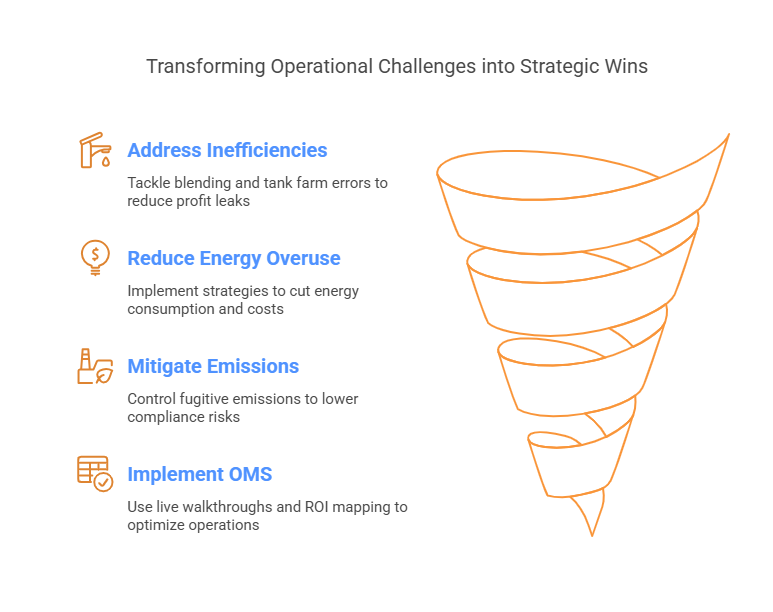
Not all pain points are created equal. A targeted approach means prioritizing those directly affecting margins, emissions, safety, or unplanned downtime.

Common focus areas include:

  • Inefficiencies in blending systems
  • Errors in tank farm operations
  • Fugitive emissions management
  • Overuse of steam, power, or nitrogen

According to KBC’s Digitalization in Refineries, identifying and addressing these weak points can unlock millions in value when connected with the right digital tools.

Use Value Mapping to Target Pain Points Through Refinery Digitalization

OMS helps clients map operational pain points (e.g., product giveaway, tank movement delays) to digital interventions with proven ROI. Through collaborative workshops and live process walkthroughs, OMS helps transform operational nuisances into strategic value drivers.

Step 3 – Build the Business Case for Refinery Digitalization

Use ROI Modeling to Prioritize Refinery Digitalization Projects

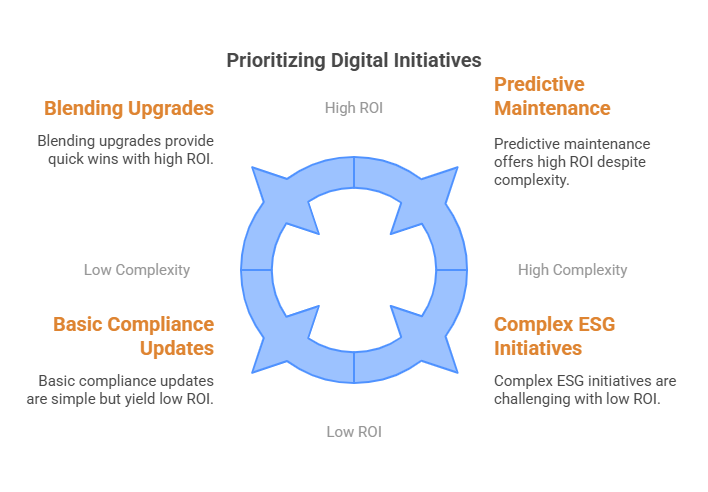
Not every digital project delivers equal impact, especially in capital-intensive environments like refining. Prioritizing initiatives based on return on investment (ROI) ensures that decisions are technically sound and financially strategic. Quick wins such as predictive maintenance, energy dashboards, or blending control upgrades often deliver high returns with minimal capital outlay. For example, AspenTech reports that predictive maintenance can reduce expenses by 20% and cut unplanned failures by 40%. But ROI isn’t just about savings—decision-makers should also weigh payback period, deployment ease, and alignment with ESG or compliance goals. Projects that improve emissions reporting or operational safety often secure broader buy-in from legal, finance, and sustainability teams.

OMS supports this with a refinery-specific ROI modeling framework that accounts for real workflows, implementation complexity, and business impact. These tools bridge the gap between engineering priorities and executive goals, making digital transformation measurable, justifiable, and scalable.

  • Evaluate cost savings and strategic alignment.
  • Include payback period, complexity, and ESG impact.
  • Identify quick wins with high operational ROI
  • Justify blending and energy upgrades with real data.
  • OMS modeling speaks both operational and financial language
  • Make smarter digital bets—grounded in value, not hype

Step 4 – Align Refinery Digitalization with Strategic and ESG Goals

In today’s ESG-driven landscape, digital transformation must boost margins and support broader goals.

Every digital project must be aligned with your key performance indicators (KPIs), whether reducing CO₂ emissions, enhancing operator safety, or improving product yield. As DigitalRefining’s Business Case for Digitalisation points out, this alignment ensures funding and cross-functional buy-in from finance, compliance, and safety teams.

Build KPI-Aligned Digital Roadmaps for Refinery Success

OMS helps refineries design and sequence digital projects that boost performance and sustainability metrics. The roadmap ensures that transformation efforts drive measurable ESG impact while aligning with regulatory commitments and strategic business goals.

Step 5 – Start Small and Scale Refinery Digitalization

Pilot Programs for Refinery Digitalization with Measurable KPIs

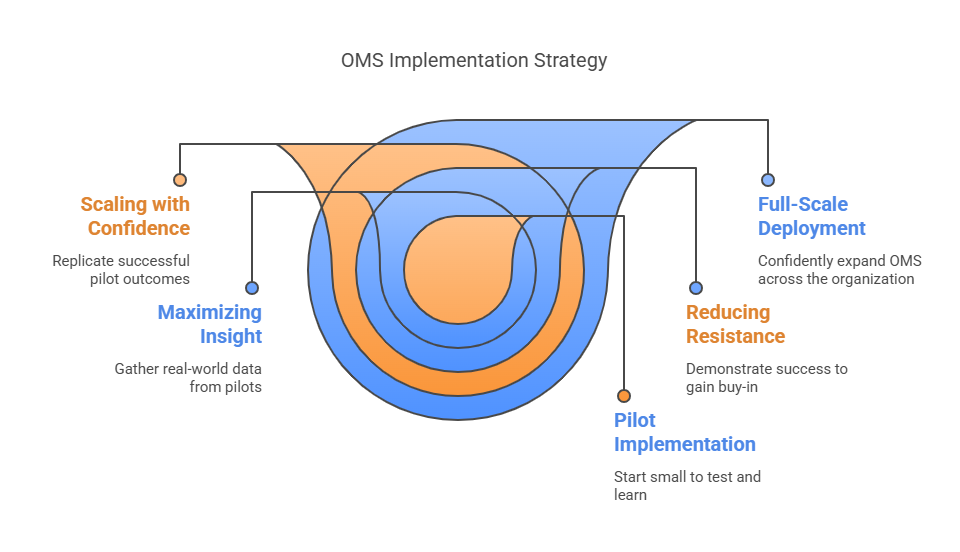
Digital transformation doesn’t have to begin with sweeping, high-risk overhauls. The most effective approach often focuses on starting small, proving value, and scaling. Piloting a digital solution in a specific unit, such as a crude distillation unit with blending inefficiencies, allows for real-time validation of performance indicators while minimizing operational disruption.

These controlled environments are testbeds for fine-tuning system architecture, gathering operator feedback, and resolving integration issues before a broader rollout.

  • Emerson’s Refinery Digital Transformation Case Study highlights that successful pilot programs help build internal momentum, reduce change resistance, and accelerate department adoption.
  • When done right, pilot programs are not just technical experiments—they’re strategic proof points that show how digital tools can deliver measurable improvements in safety, efficiency, and profitability.
  • OMS specializes in designing and executing scalable pilot programs with clearly defined KPIs from day one.
  • These pilots are intentionally narrow in scope but deep in insight, allowing stakeholders to evaluate real-world performance before committing to full-scale deployment.
  • Once validated, OMS transforms these pilots into replicable templates that streamline implementation across multiple units or refinery sites.
  • This modular, pilot-to-scale approach ensures that each step in the transformation journey is data-driven, risk-mitigated, and aligned with strategic goals.

Step 6 – Upskill Teams for the Digital Refinery Workflow

A common myth in digital transformation is that upgrading means overhauling everything. In reality, the more innovative—and often more sustainable—path is to layer new digital capabilities onto existing infrastructure.

  • Most refineries have invested heavily in Distributed Control Systems (DCS), SCADA, or PLC platforms. Replacing them outright is not only costly but often unnecessary.
  • With the rise of edge computing, cloud-based analytics platforms, and middleware integration, it’s now possible to build a digital layer of intelligence that connects seamlessly with legacy systems.
  • This hybrid architecture enables faster deployment, minimizes CAPEX, and avoids the operational disruptions that full system replacements often entail.
  • Aramco’s Yanbu Refinery transformation is a standout example of this strategy, which uses clever layering instead of system rip-and-replace to achieve digital maturity.

Step 7 – Sustain Refinery Digitalization with Governance & Scalability

OMS embraces a non-disruptive, hybrid approach to digital integration, combining AI/ML models, soft sensors, and real-time simulators with your refinery’s existing control layers. This strategy ensures that your prior investments in control systems remain intact while unlocking new operational insight and decision-making speed levels. The result? More brilliant performance without system downtime.

Use Feedback Loops to Optimize Refinery Digitalization Over Time

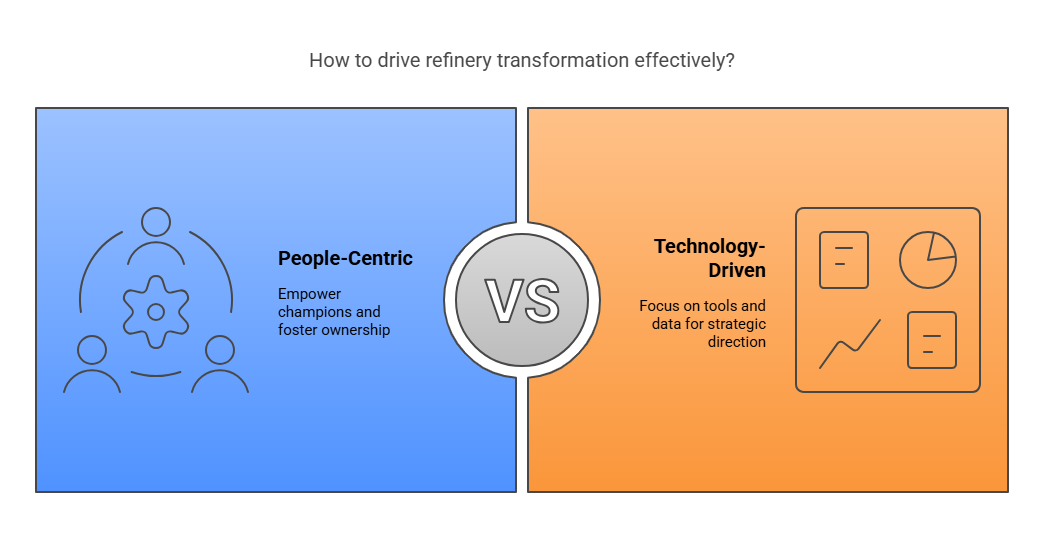
Technology is only as powerful as the people who use it. As refineries evolve, so do the roles of their operators, engineers, and planners.

  • The next generation of workflows will demand familiarity with dashboards and analytics tools and the ability to interpret data, simulate responses, and make informed decisions under pressure.
  • Training needs to go beyond button-clicking and interface walkthroughs. It must be scenario-based, role-specific, and operationally realistic.
  • Programs like Texas A&M–Corpus Christi’s Refinery Operations Course emphasize this shift. In it, digital acumen and plant know-how come together in simulated environments that reflect the true complexity of refinery operations.
  • To meet this need, OMS offers a modular, simulation-driven eLearning platform explicitly designed for the refinery context.
  • Every learner engages with role-relevant, scenario-rich training modules that mirror real-world operational challenges, from control room operators to long-term planners.
  • This isn’t just training—it’s transforming workforce readiness for the digital refinery era.

Sustain Progress with Governance and Measurement

Create Feedback Loops for Continuous Improvement

Digital transformation doesn’t end at deployment—it evolves through refinement. For refineries to sustain long-term value, it’s critical to establish real-time feedback loops that track adoption, usage patterns, and performance outcomes.

This means going beyond static dashboards to monitor KPIs continuously, assess how tools are being used on the ground, and identify where interventions are delivering value or falling short. Non-performing tools must be improved, repurposed, or retired to maintain strategic focus and resource efficiency. As McKinsey’s report on AI-powered organizations emphasizes, sustained digital success hinges on responsiveness, not just implementation.

OMS Performance Tracking Tools

OMS enables this evolution through performance dashboards with embedded KPI benchmarking and usage analytics. Plant managers gain visibility into which digital tools drive impact, which need optimization, and how strategic plans should adapt. This capability ensures that digital transformation remains a living process, not a one-time event.

Plan for Versioning and Scalability

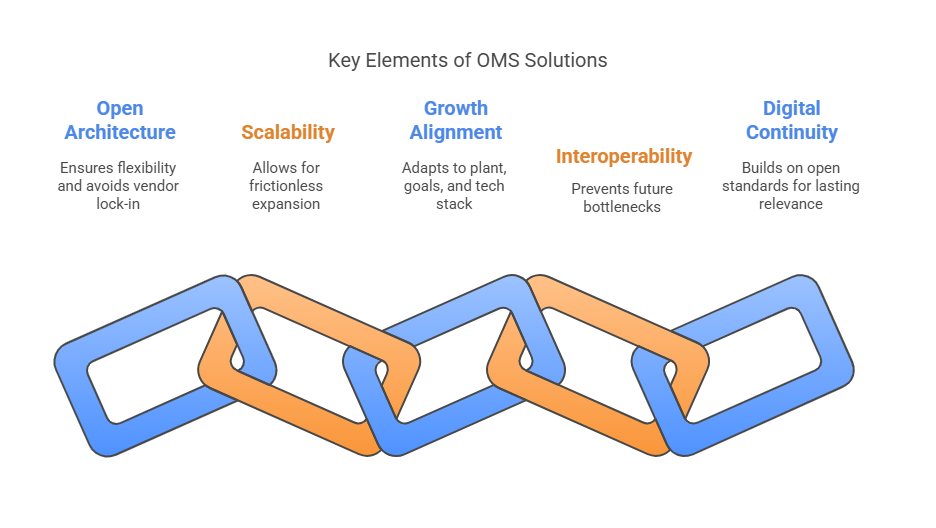
Future-proofing a refinery isn’t just about today’s performance—it’s about tomorrow’s adaptability. Digital ecosystems must be built on open, modular architectures that support upgrades, expansion, and third-party integrations without the friction of vendor lock-in or obsolete infrastructure.

Refineries can ensure the growth of their digital infrastructure by emphasizing interoperability, modularity, and scalability, whether scaling across units, integrating with logistics, or expanding to other plants. As the ARC Advisory Group outlines, open standards are the cornerstone of digital continuity.

OMS Future-Proof Architecture

OMS designs every solution with a standards-based, interoperable architecture that ensures seamless scalability across process units, multiple refineries, and even adjacent domains like distribution and supply chain. This approach empowers clients to build once and scale confidently.

Conclusion

The refinery of the future will not be defined by the most expensive technology but by the smartest strategy. Digital transformation isn’t about ripping and replacing—it’s about layering intelligence onto your existing foundation, enabling people to make faster, better decisions, and aligning every initiative with your long-term goals.

Refineries that follow a structured, feedback-driven roadmap—with clearly sequenced priorities, empowered teams, and flexible architectures—achieve operational efficiency and strategic agility.

With the right technology partner, digital transformation becomes more than a project—it becomes a performance engine. As the World Economic Forum’s Digital Transformation Initiative affirms, the actual driver of success is not complexity, but consistency. The future is already within reach for refineries ready to lead the next era of energy and efficiency.

Digital Transformation

Refinery Digital transformation is now a necessity, not a future goal. In today’s fast-moving energy landscape, standing still means falling behind. Outdated technology increases risk, drains revenue, and invites regulatory trouble. The hidden cost of “doing nothing” keeps growing. This blog explores how digital delays hurt performance—and how OMS helps turn those risks into smart, value-driven upgrades.

Delaying Action? The Real Cost Behind Refinery Digital Transformation Inertia

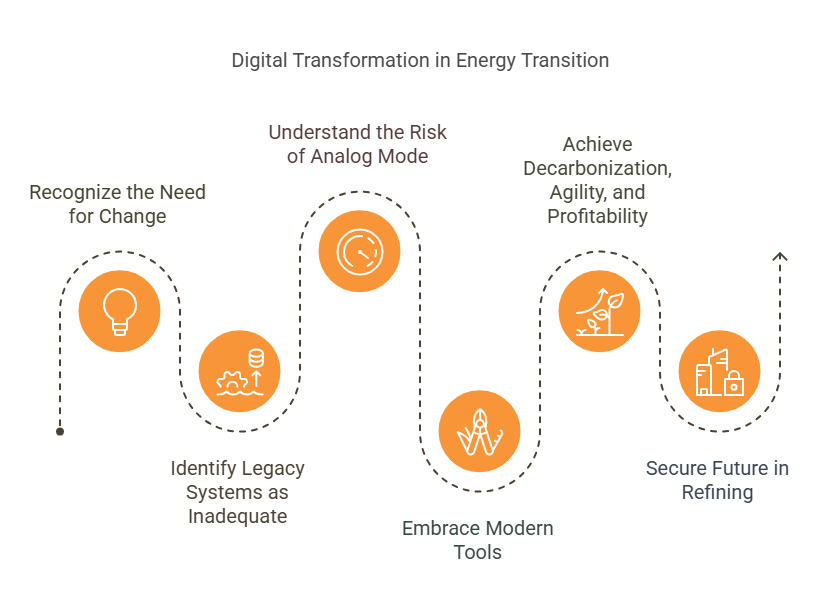
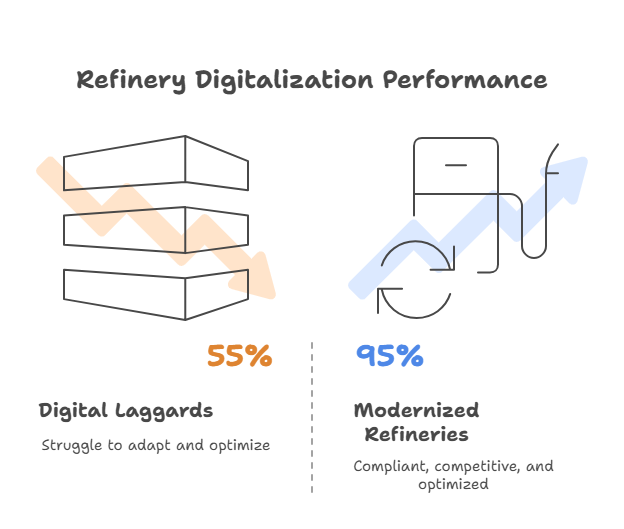
Digital transformation is no longer a futuristic ambition but a present-day necessity in the refining sector. According to Bain & Company’s detailed analysis on Energy Transition and Digitalization, refineries that delay modernization risk falling into what the report calls the “digital laggards’ trap”—a cycle where outdated systems not only limit operational efficiency but also block access to decarbonization initiatives, advanced trading models, and low-carbon innovation.

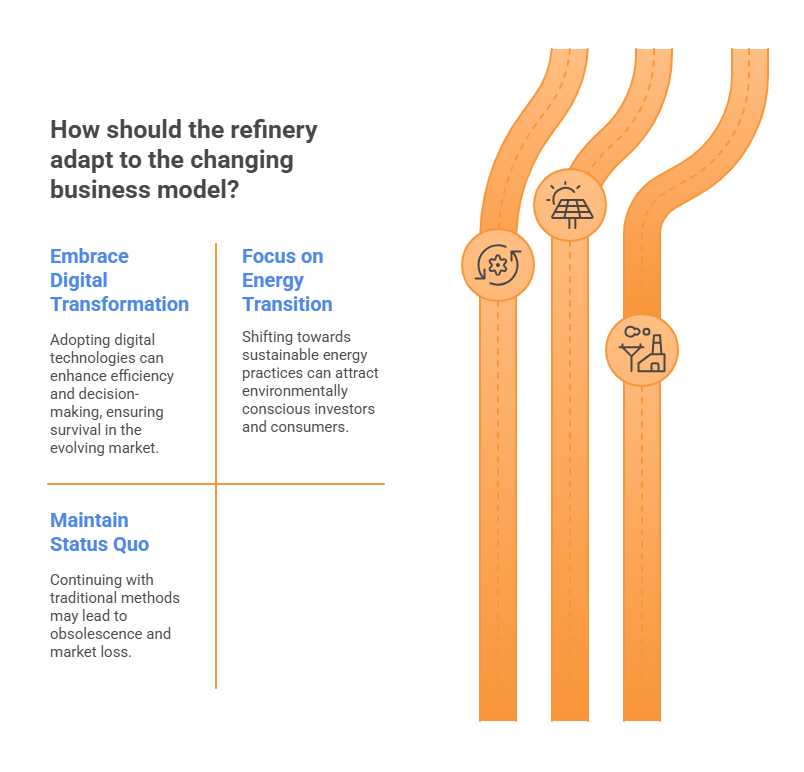
As the industry shifts toward cleaner fuels, circular operations, and stricter emissions rules, digital tools are becoming essential for staying compliant and competitive. But many refineries still rely on legacy systems designed for a more linear, analog world. These outdated setups can’t keep up with the fast-moving demands of today’s energy transition. Without core technologies like advanced process controls, real-time analytics, and integrated digital platforms, these facilities risk being left behind in the push toward a low-carbon future.

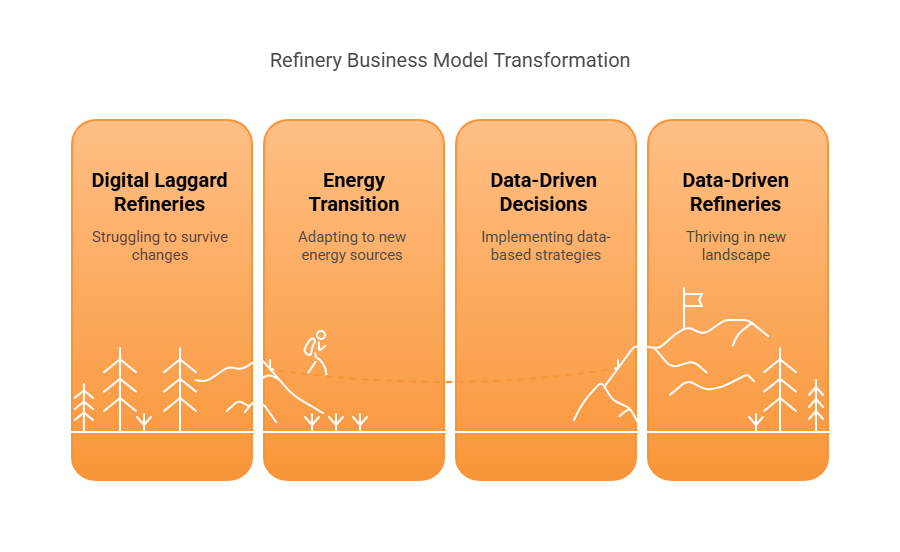
“Digital laggards will struggle to survive as energy transition and data-driven decision-making reshape the refinery business model.”
— Bain & Company, Refining in Transition

The impact of falling behind goes far beyond just missing environmental goals. Refineries stuck with outdated systems also lose their edge in the market. They struggle to adapt quickly, miss out on optimizing throughput, and often can’t tap into high-margin trading opportunities. This makes them less appealing to investors and partners who care about ESG performance.

That’s where OMS comes in. 

  • Its Digital Maturity and Performance Gap Assessment is explicitly designed for refineries. 
  • It examines your current technology setup and compares it to industry standards and decarbonization goals. Instead of pushing expensive, large-scale changes, OMS focuses on smart, low-risk upgrades—like improving blend logic or adding analytics tools—that make a difference. 

The result? A custom roadmap that helps you modernize safely, strategically, and without disrupting operations.

Hidden Losses That Add Up: Why Postponing Refinery Digital Transformation Is Expensive

Beyond visible inefficiencies lies a massive layer of hidden costs, often overlooked until they reach crisis levels.

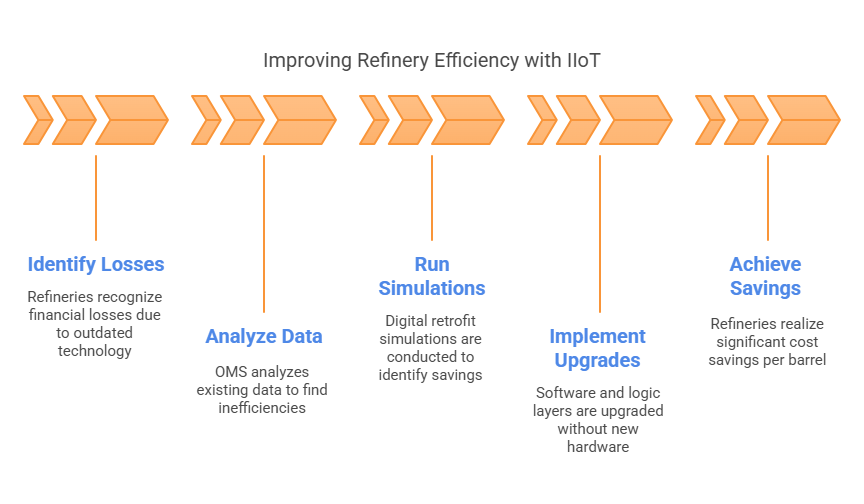
According to a study by Emerson, facilities processing 250,000 barrels per day lose an average of $12.3 million per year due to outdated technology and a lack of Industrial Internet of Things (IIoT) integration. These losses manifest in wasted energy, high maintenance costs, delayed blending, and poor scheduling decisions.

  • OMS helps close that gap with its ROI modeling services, which closely examine off-site systems, blending setups, and utility use. 
  • By working with the data you already have and running digital retrofit simulations, OMS often finds hidden savings of $0.20 to $0.40 per barrel just by upgrading software and logic layers—no new hardware is needed. 
  • It’s a smart, cost-effective way to boost performance where it counts.

Is Legacy Equipment Blocking Your Refinery Digital Transformation Goals?

While legacy infrastructure may appear reliable on the surface, it often conceals a range of operational inefficiencies and financial liabilities. For refineries, the hidden costs of sticking with outdated systems, especially in bottom-upgrading units and downstream transfer processes, can severely undermine profitability and long-term competitiveness.

What Old Infrastructure Costs You in the Refinery Digital Transformation Journey

Worley’s report on Refinery Bottom-Upgrading underscores a key industry dilemma: many refineries still rely on decades-old heavy oil processing units not designed for today’s crude slates or product quality requirements. 

  • Older bottom-of-the-barrel units often struggle with low conversion efficiency, higher sulfur content, and more fuel oil production, all of which reduce the recovery of high-value products and cut into margins.
  • As the industry shifts toward lighter, cleaner fuels and value-added petrochemicals, outdated infrastructure becomes a significant roadblock. 
  • These legacy systems are just not built to handle today’s demands, which means refineries can miss out on profitable opportunities—not because of a lack of strategy but because their hardware simply can’t keep up.

OMS tackles this issue through detailed Process Unit Reviews that identify inefficiencies in blending systems, tank farm transfers, and downstream yield management. Instead of recommending costly replacements, OMS engineers focus on logic reengineering, smart integration, and modular retrofits—unlocking performance improvements using the plant’s existing assets. In many cases, margin realization improves simply by re-strategizing how units interact with each other, rather than replacing them outright.

Reducing Safety Risks and Downtime Through Smarter Refinery Digital Transformation

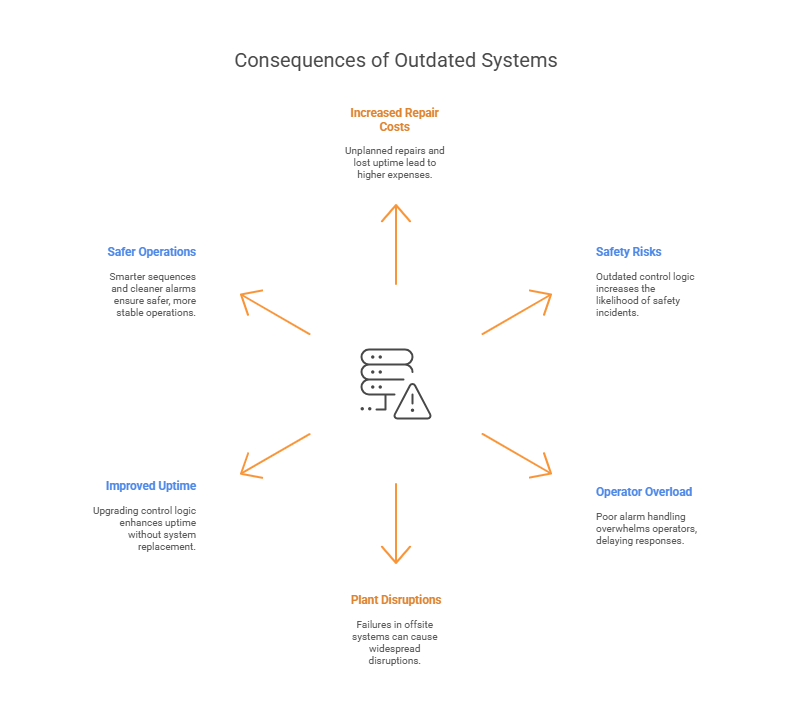
The operational risks of aging infrastructure extend far beyond margins. Energy Career Magazine’s article on Revitalizing Infrastructure highlights that older systems typically require more reactive maintenance, are prone to frequent unplanned outages, and expose operations to higher safety risks due to outdated control logic and poor alarm handling.

  • This is especially problematic in off-site systems like blending, tank management, or utilities, where failure in one sub-system can cascade into plant-wide disruptions. 
  • Moreover, aging equipment often lacks modern systems’ diagnostics and predictive maintenance capabilities, resulting in costlier failures and slower recovery times.

OMS offers targeted upgrades to control logic to tackle these challenges without replacing entire systems. 

  • These include optimizing PLC/DCS systems, updating interlocks, and cleaning up alarm overload. 
  • By redesigning how control sequences work and reducing unnecessary alerts, OMS helps operators stay focused and avoid potential shutdowns before they happen. 
  • These upgrades boost uptime and throughput while making the workplace safer, especially in critical areas like blending and utility balancing, where small mistakes can have significant consequences.

Digital Twins, Retrofits & ROI: Smart Ways to Approach Refinery Digital Transformation

Contrary to popular belief, modernization doesn’t always require massive capital expenditures or shutdowns.

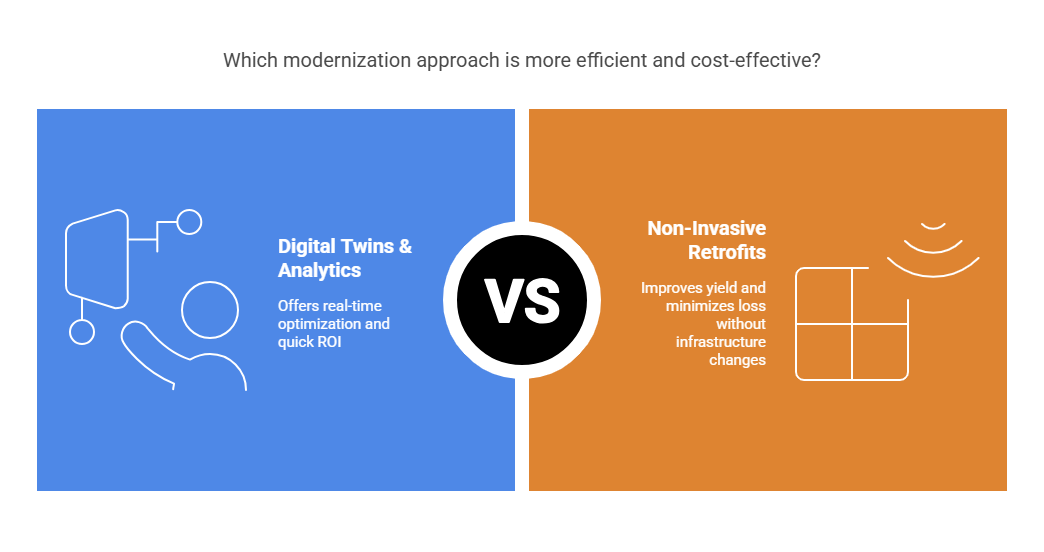
Schneider Electric highlights the value of Digital Twins and Advanced Analytics in real-time energy optimization, maintenance prediction, and asset reliability. These technologies are modular, easily integrable, and often pay for themselves within 12–18 months.

OMS’s Smart Digital Retrofit Model

OMS specializes in noninvasive retrofits, overlaying smart sensors, AI-driven control loops, and tank blend optimizers without touching the core infrastructure. The result? Improved yield, optimized steam distribution, and minimized tank heel loss.

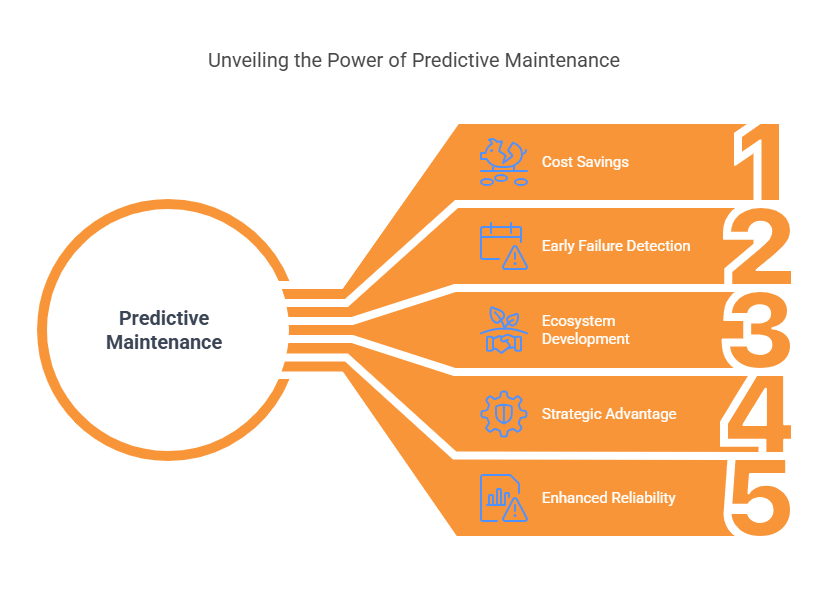
Refinery Digital Transformation with Predictive Maintenance Pays Off Long-Term

AspenTech’s case study shows that predicting pump failures over 35 days in advance can save up to $30 million by giving operators time to act without disrupting production. Building on this proven value, OMS takes a collaborative approach to rolling out Predictive Maintenance (PdM).

By working closely with condition-monitoring partners, OMS helps design innovative sensor placement strategies, build effective data analysis pipelines, and integrate insights directly into the reliability-centered design of off-site units. The result is a seamless PdM ecosystem that doesn’t just prevent failures—it enhances long-term efficiency and equipment health. So, why wait for a breakdown when you can predict it?

Can’t Afford a Major Overhaul? Budget-Friendly Paths to Refinery Digital Transformation

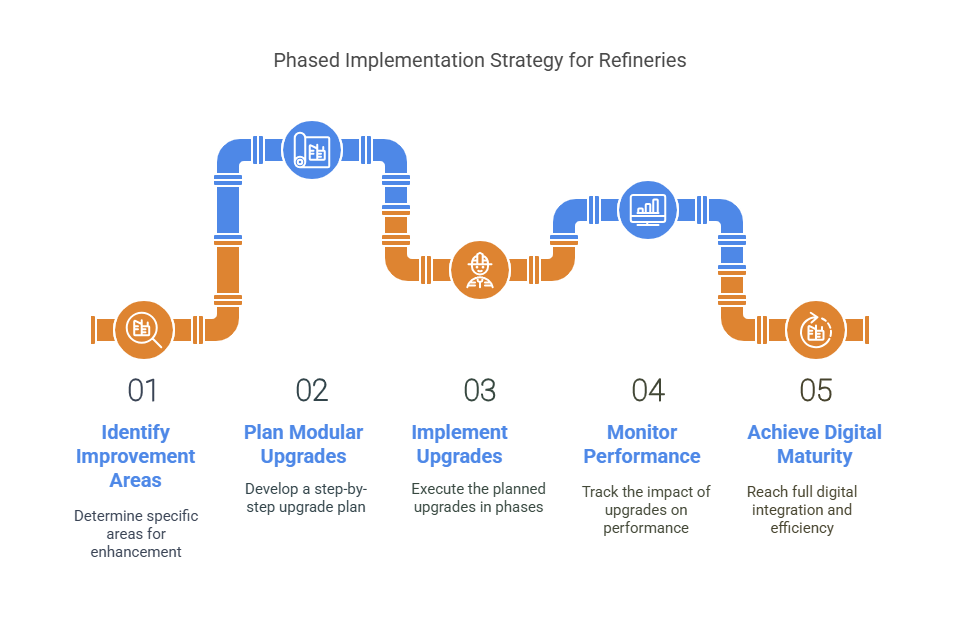
For many refineries, the most significant barrier to modernization isn’t lack of intent—it’s the perceived financial disruption. Full-scale overhauls often have high CAPEX, prolonged downtimes, and operational risk. But as Shell Global’s experience with Refinery Revamps demonstrates, a more pragmatic alternative is modular, phased upgrades that deliver value incrementally while preserving day-to-day operations.

Modular Upgrades: A Practical Strategy for Refinery Digital Transformation

Shell’s revamp strategy is an excellent example of how targeted, step-by-step improvements can boost performance and cut costs without shutting down an entire plant. Whether upgrading a crude distillation unit or adding energy-saving features, Shell’s modular approach keeps operations running while modernizing systems in manageable stages. This avoids the disruption of complete shutdowns and makes planning upgrades around production schedules and budget limits easier, which helps maximize ROI.

For refineries with tight budgets or those cautious about changing long-standing processes, this phased approach offers a smart, practical path forward: steady improvements without significant interruptions.

  • OMS follows the same logic with its Phased Implementation Model, delivering modular upgrades like blend model tuning, tank automation, and alarm management based on each client’s goals and funding. 
  • Each phase is designed to stand alone, so refiners immediately see real results while pursuing long-term digital growth. 
  • It’s a flexible way to reduce disruption, control costs, and progress toward full digital maturity—one step at a time.

Training Your People Is the Backbone of Any Refinery Digital Transformation Plan

Technology alone doesn’t transform a refinery—people do. Even the most advanced digital systems can underperform if operators aren’t confident using them or if institutional culture resists change. That’s why embedding a robust training strategy into every upgrade is essential for implementation success and long-term return on investment.

Building capability through eLearning

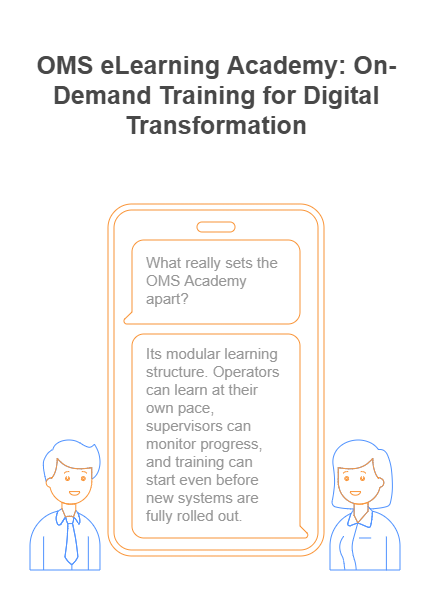
The OMS eLearning Academy is a refinery-specific, on-demand training platform that helps teams prepare for digital transformation from the ground up. Its simulation-based courses are built around real-world refinery scenarios—from tank farm automation to offsite control strategies—and they’re accessible anytime, on both desktop and mobile devices.

What sets the OMS Academy apart is its modular learning structure. Operators can learn at their own pace, supervisors can monitor progress, and training can start even before new systems are fully rolled out. This proactive approach helps teams get comfortable faster, reduces mistakes during the transition, and ensures that new technology is used well, delivering real value from day one.

“Training shouldn’t be an afterthought. It should be embedded into every stage of the upgrade journey—starting before deployment and continuing beyond it.”
— OMS eLearning Academy

Simulation-Based Learning: The Human Side of Refinery Digital Transformation

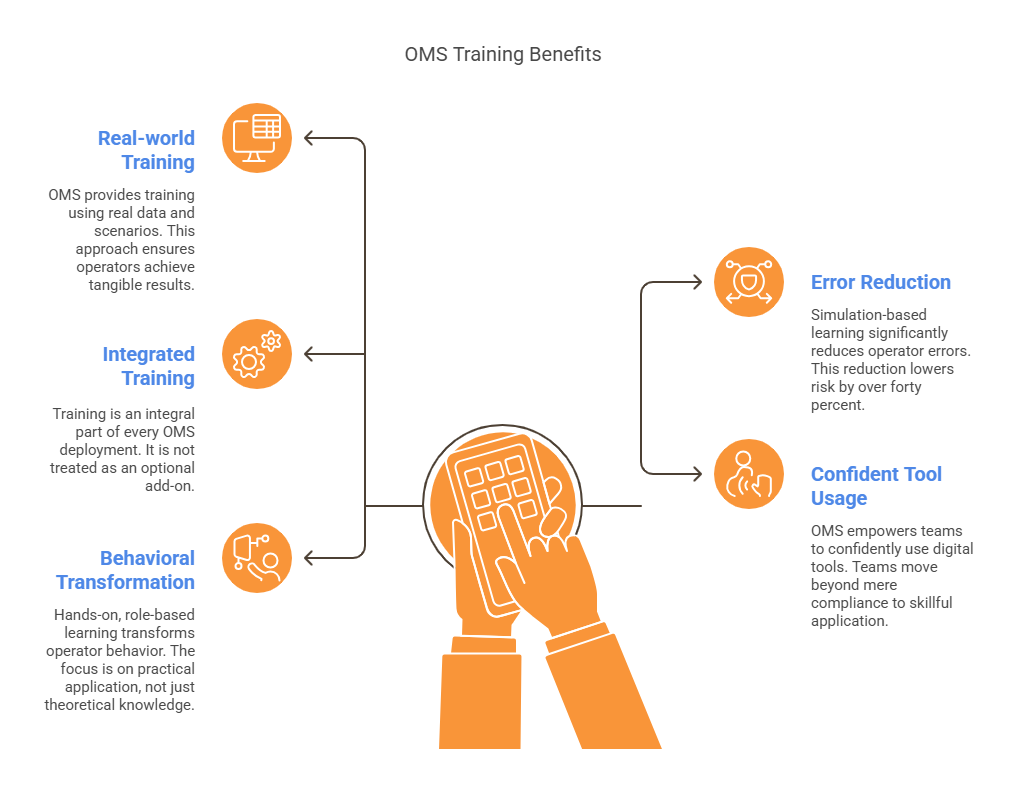
Every OMS deployment comes with a customized training plan built around the specific technologies being introduced. These plans include interactive digital simulations, hands-on operator labs, and role-based modules designed to make learning easy to understand and remember.

  • The goal is straightforward: ensure teams know how to use new digital tools in their daily decisions. 
  • By weaving training into the rollout timeline, OMS goes beyond just checking a compliance box—it helps people change how they work. 
  • This focus on people, not just systems, is why OMS training has such a lasting impact—it is scalable, measurable, and built to last.

A report in the AIChE Chemical Engineering Progress (CEP) journal found that structured, simulation-based training can reduce operator error by over 40% and significantly improve adherence to safety procedures. That’s a powerful way to reduce risk.

OMS takes this even further by creating custom training simulators using actual plant data. This allows staff to practice real scenarios before they happen—whether handling a blending shutdown, managing tank transfers, or executing a steam purge. It’s one of the most effective ways to build confidence and reduce mistakes in high-risk operations.

Outdated Systems Are a Liability—Refinery Digital Transformation Makes You Future-Ready

In refineries, every barrel matters. And so does every second of downtime, every unexpected shutdown, and every unoptimized blend. The compounding effect of old technology, poor training, and reactive maintenance is not just a technical concern—it’s a strategic risk.

The good news? Refineries don’t need to leap into full-scale digital transformation. With the right strategy, modular upgrades, and human-centric training, even the most legacy-heavy plant can evolve into a high-performance facility.

OMS is committed to making this transition smart, safe, and ROI-driven.

Your refinery operations deserve smarter automation

From tank farm control to hydrocarbon loss reduction, Global OMS delivers digital solutions trusted by refineries worldwide.