Introduction
Continuous education means different thing to different people. Some call it is getting higher degree, some call it professional training. No matter what it is understood for, one thing stood among all learn more by any means and for any purpose. Continuing education is migration and transition from academic world to the real world. The academy institutions teach us all fundamental foundation of our education discipline, weather be medicine, science, engineering, finance, you name it, but when step into the real world, it is all together a different scenario. Yes, we are equipped mentally and by educational training to tackle a problem in our profession. If we don’t know how to solve a problem, we Google it and get the information in an instant what we want. But that kind of information retrieval in the modern internet era is intermittent, specific in nature and does not help our profession in a very systematic manner. This is where the concept of continuing education comes into play.
This is a very fast world where information, technology and science change every minute. What we have learned in the academia will be outdated very soon if not already been so. To catch up with fast moving world, we must keep on learning as our own will or as a requirement to keep our professional knowledge up-to date for certification purpose. There are many options for doing so and they vary in terms of cost, timings, suitability to your career etc. We will discuss those in next paragraphs.
Modes of continuing Education
After we start our business or industrial career after the completion of academic education, we are presented with the following options and they all their pros and cons as follows:
- On the job or in-house training – Normally, all employers, specially the large corporations, have a schedule set of training for newcomers. These courses are mostly generic in nature and do not focus on your job responsivity. This requires in-house expertise to mentor or transfer knowledge in systematic manner. Sometimes, in-house experts and trainers are retired or not available.
- External public courses – Sometimes, the companies enroll the employees in public courses to help employees acquire skills required for a specific project. They are expensive for the employers and do not allocate budgets most of the time. Even they do, it is pool budget for a department and not everybody can attend public courses or conference etc.
An extension of this option is to hold onsite private course for a group of employees by an instructor who teaches the desired courses as public courses. This can reduce the travel expenses of employees. The disadvantages of this option are that employees being on site get disrupted all the time and training does not become very ineffective.
- Self–study manuals or subject related books – This option is always available to all and any time, is also inexpensive for most part of it. However, it is slow process to gain additional skills and there is no interaction or real mentor to guide.
- Online courses or eLearning – It is known by names and has many methods of delivery. It is all grouped under the common terminology of “distance learning meaning remote learning without human face-to-face interactions. It varied in methods like postal delivery of lectures, radio/television and now on online using the internet technology since the arrival world wide web (WWW) in 1991. This mode of continuing education took off to a 300 Billion industry today and helps all either got get academic degrees or professional certifications regardless of their industry.
Comparative cost of Continuous Education Options
Let us take a case study and compare person student cost of all modes of continuous education. We consider the following cost model of continuous education options for a corporation for the training of 10 students.
- Number of students taking a course = 10
- Average Cost of 3 days’ public course fee + expenses = $4,000
- Average Cost of 3 days’ onsite course by external instructor = $1,600
- Self-study Course manual = $800
- Cost of eLearning course equivalent to 3 days’ public course = $1,200
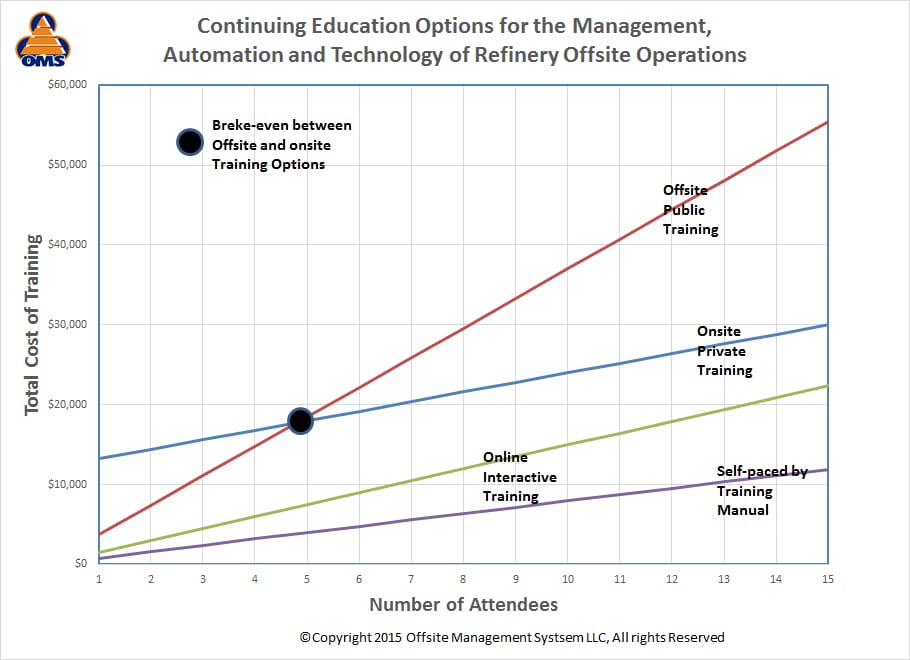
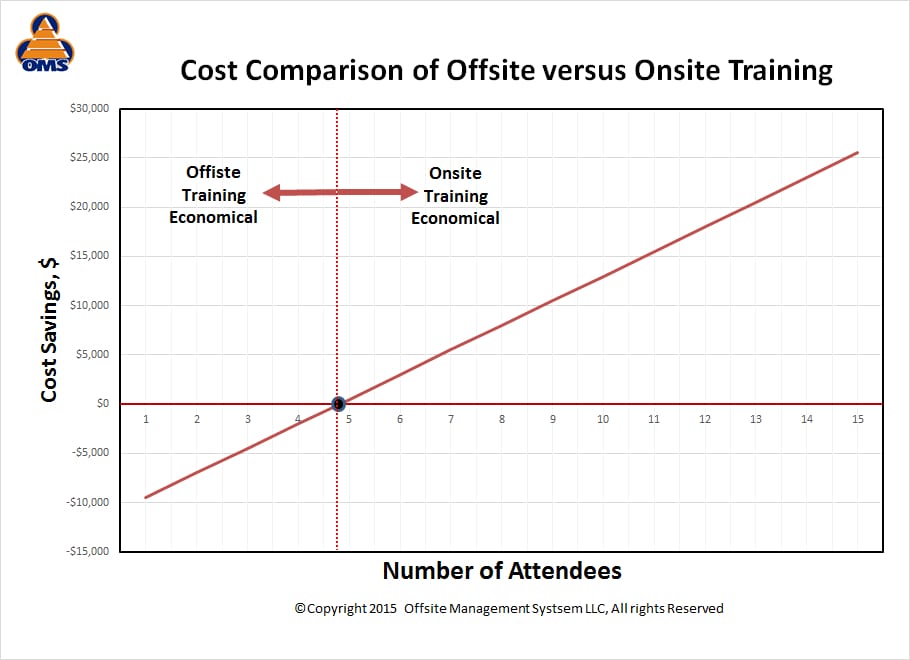
This data is represented graphically in figure 1. We can see that threshold numbers of students for offsite versus onsite is only 4. Now this is only for one course curriculum and the cost of training for more students and for more curriculum will cost any corporation millions of dollars per year. The cost is recurring for movement of employees in and out or across of company or across departments. Self-study option may be least expensive, but it is considered practical from time management point of view.
Hence, eLearning option of continuing is very cost effective, sustainable and manages professional time efficiently. We can see that eLearning cost about 30% of the public courses. That is a huge savings in terms of training cost for a corporation. For this reason alone, the market for eLearning industry is about 325 billion dollars as reported in the media [1]. Next, we will discuss what are the attributes of an eLearning curriculum and later illustrate with an actual eLearning curriculum, developed by the authors of this paper, for the downstream refining industry
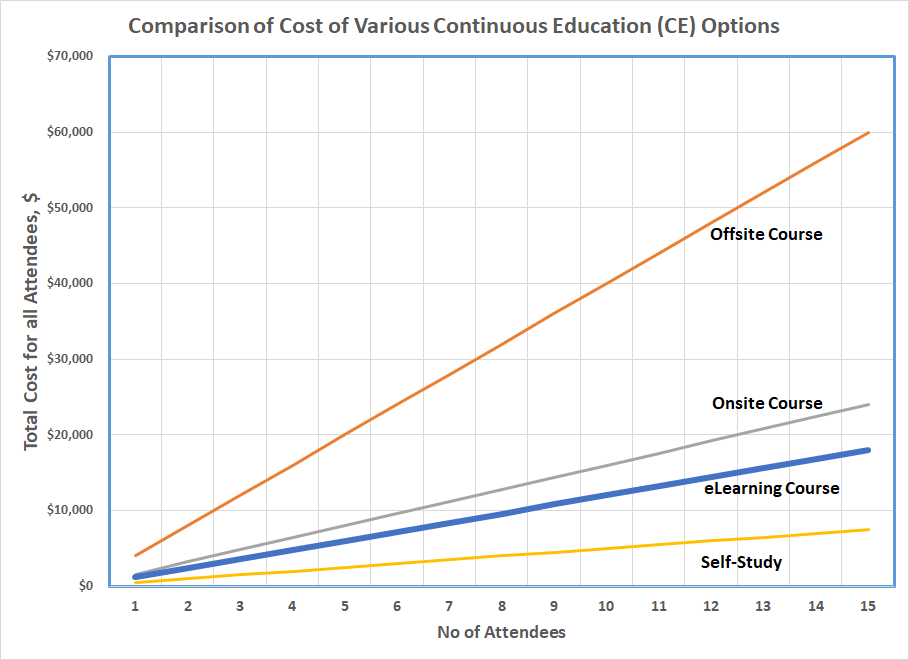 |
Figure 1 Comparative Cost of CE Options
Attributes of an eLearning Curriculum
We will next discuss the most common attributes and features of a typical eLearning curriculum in terms of platform, format, globalization, progressive eLearning mode and Drip schedule etc.
- Platform – There are few options for eLearning curriculum that are offered in the learning industry. They can be either based on general platform like Thinkific, Teachable, uDemy etc. This option is not very flexible from customization and corporate branding point of view. Next option is to use WordPress plugins like LearnDash, lifterLMS, WP Courseware etc. This option gives more flexibility for customization to create a brand but is much more expensive compared to a universal platform because one to hire a team of professionals to create an eLearning system using the plugins and brand it to same look and feel as the corporate website. Some curriculum is also available on YouTube in the form of video but with no CE certification.
- Format – An eLearning curriculum can have combination of pdf slides, PowerPoint slides, live narration with subtitle etc. Some curriculum have interactive format for users to interact and is more complex to develop. Subtitles help hearing impaired professional to learn as well just like others. The contents can be just textual or combination of texts and graphics. There are wide variation in the delivery methods of eLearning contents and depends the complexity of lessons and target students.
- Progressive eLearning Mode – Just like a classroom learning, eLearning also follows a systematic method of teaching. That is the student must follow sequence of chapters /sub-chapters and lessons to complete in progressive manner and cannot advanced and skipped to gain knowledge in orderly fashion and earn certification at the end by completing an exam with passing grades. The progressive learning is linked with Drip schedule with payment plan for the curriculum as well. The lessons are released as the payments are made by the user for payment plan or subscription.
- Globalization – An eLearning curriculum may be offered world-wide and hence must consider its globalization in terms of multi-lingual contents, audio and captions. As translation of contents and multi-lingual recording is very expensive, most curriculum offer in English or local language and use site language translation plugins or Google translator. Both methods of multi-language offerings of curriculum is very expensive and hence not offered most of the time.
- Target Audience – The target for an eLearning curriculum can vary from Kinder Garden (KG) to professionals with higher degrees (PhD, M.D, MBA). They can also focus on their professional levels like executive management, managers, engineers, fresh graduate or employees etc. There is something for everybody in the eLearning world. The curriculum can be very simple and easy to follow or can be multi-levels courses and sub-courses. They also can vary in actual eLearning hours and/or actual duration for taking the courses.
An Example of eLearning Curriculum
In this article we will illustrate all attributes and complexity of an eLearning system for downstream refining industry. There are two areas of operations in a refinery, known as onsite and offsite operations. Onsite operations refers to process units and offsite refers to tank’s farms, blending, oil movement etc. and is responsible for making final sellable products. The professional in the offsite area have a slow learning, lack of training opportunities and foster employee turn-over. There are very few or non-existent public courses to offer training opportunities of professionals working in the refinery offsite operations area.
As a result, refinery loose 4-45 million dollars every year because their employees are not skilled and have no prior experience in the area of offsite operations. Hence, eLearning academy to offer curriculum for this area of refinery operations. We will discuss an illustration of eLearning curriculum and see how offers training across all job levels and professional experiences.
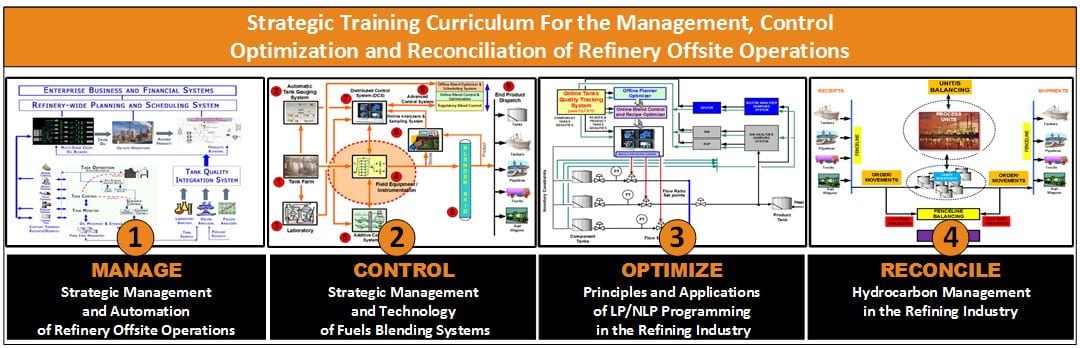
MCOR (Manage, Control, Optimize and Reconcile) curriculum – There are four aspects of refinery offsite operations as shown in Figure-2. They are how to manage infrastructure, how to control manufacturing, how to optimize production and how to reconcile hydrocarbons [2]. Normally, each one these aspect would be offered as 3 days’ public course and their schedule, if available, is very erratic and not offered for many years by few instructors in the world.
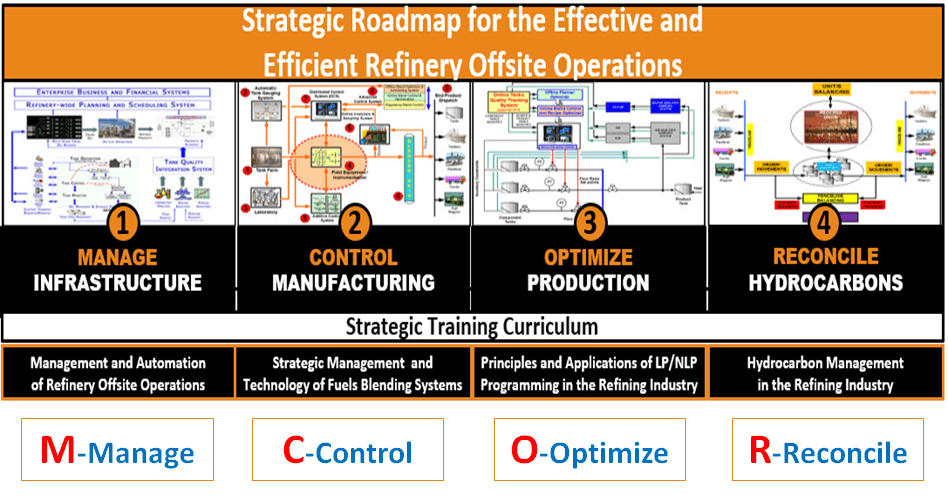 |
Figure-2 MCOR refinery Offsite Operations
These operational MCOR aspects of a refining industry affects all levels of professionals from top executives to fresh employee, but their need to learn is different at each level. Executives and managers need the general knowledge of the operations and technology to better equip them with technical background to budget projects to higher ups.
Hence, MCOR curriculum must have simpler and short yet effective curriculum for their needs. Figure-3 shows a set of eLearning curriculum for executives, manager and engineer. The engineer’s curriculum is further divided into three sub-courses for trainee, professional and engineer for progressive eLearning curriculum and learn as the engineers gets more hand-on job experience as shown in Figure-4.
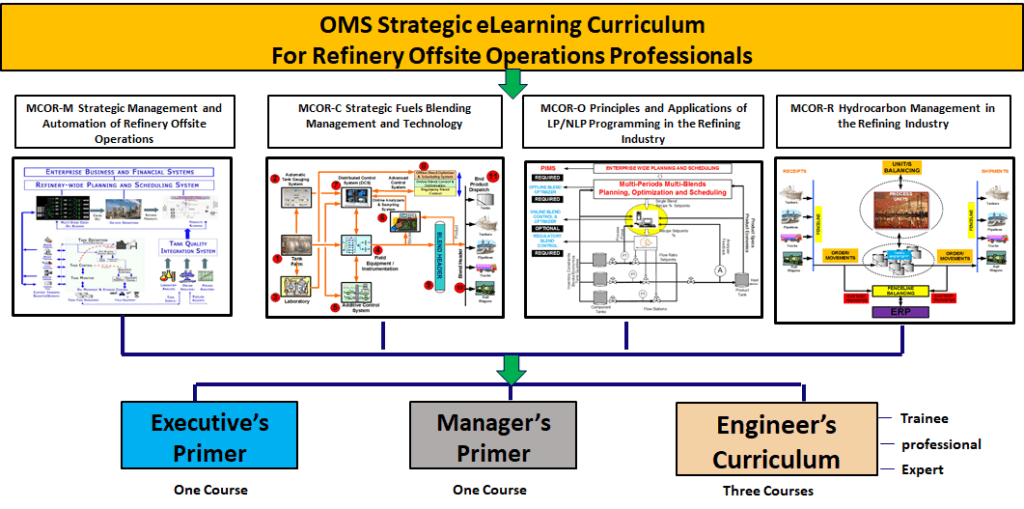 |
Figure-3 A typical MCOR Curriculum Courses
The important feature of such a curriculum, shown in Figure-4, is that every professional with both management and technical responsibilities get the same exposure to all MCOR aspects of the refinery offsite operations. They exposure and details will vary from shorter and overview curriculum to more technically complex topics faced by the engineer in his daily work.
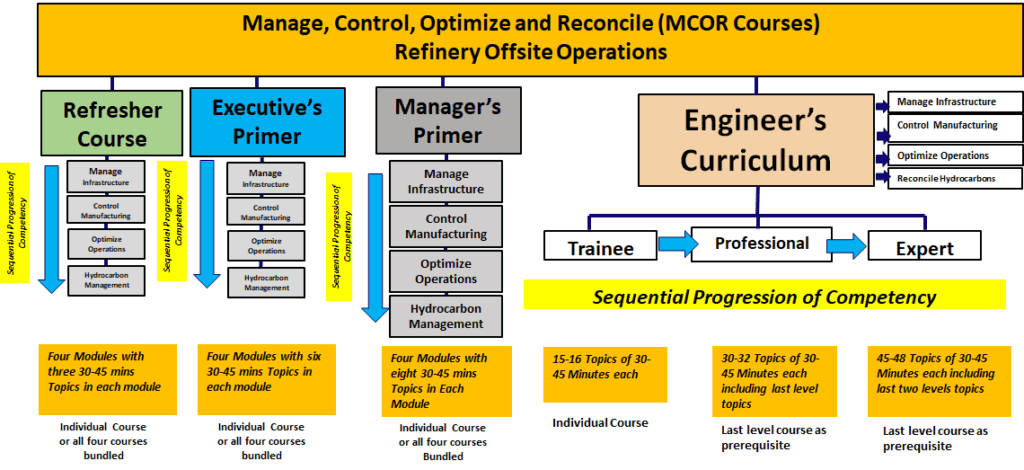 |
Figure-4 MCOR Curriculum Courses and Modules
It is important that the professionals are crammed with knowledge like in 3 days’ fact paced public courses and most of their knowledge retention is less than 60% by the time they go back to their routine. They don’t get opportunities to sync their newly learned skills with hands-on experiences in a timely fashion.
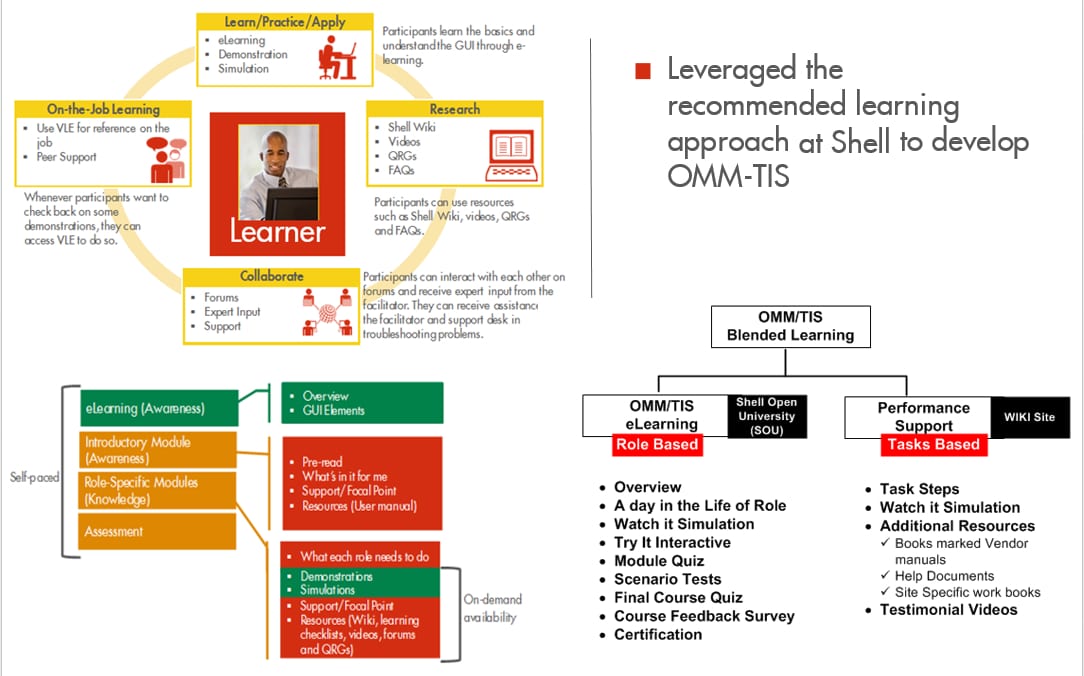
eLearning curriculum on the other hand is learn, practice and learn due to its progressive learning mode as shown in Figure-5. This is an example how a simple refresher course of 12 topics can be taken by all refinery professionals to start on a good ground before they enroll in a more extensive curriculum.
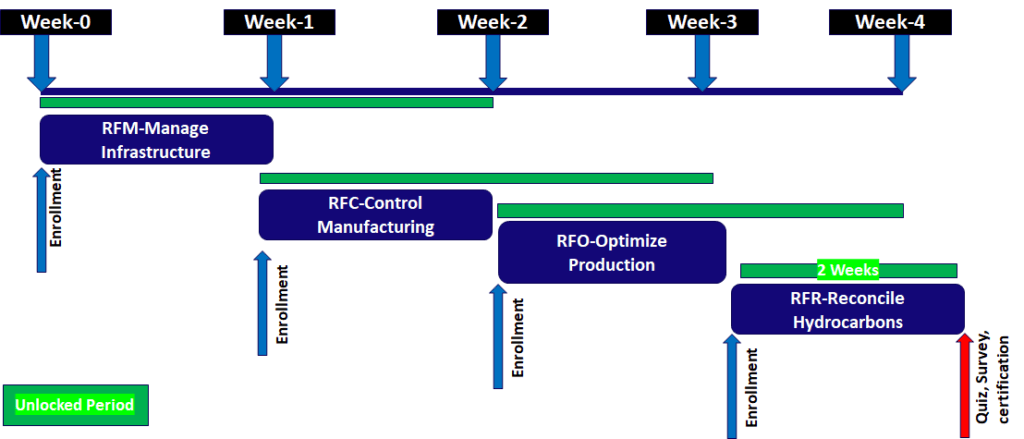 |
Figure-5 Flow of eLearning in a progressive mode
The actual learning hours and duration can vary from few hours to a year based on the time available to the enrollee as shown in Figure-6. This extended learning period simulates learning in academic class-from environment but can be take any time of the day and on any device and stop and go manner. The professional review again any topic in any order after the certification and within the unlocked period as shown in Figure-6.
All topics are always available to the enrolee for subscription-based enrollment.
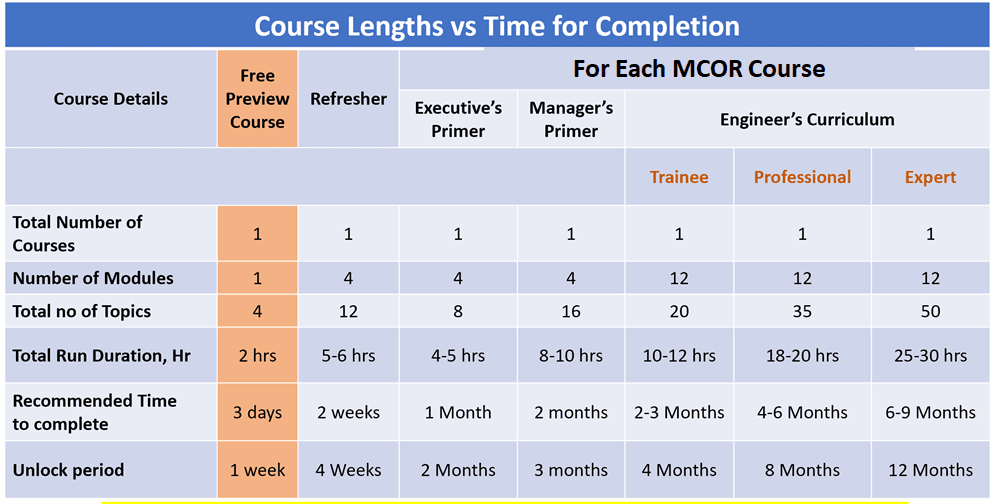 |
Figure-5 Flow of eLearning in a progressive mode
Conclusion
We have discussed in this paper that
- eLearning based continuous education is the current preferred mode of training their employees by most of the corporation regardless of the nature of their business.
- The typical cost of eLearning is 25-30% of equivalent to a publicly offered courses.
- There is not restriction on time of the day or device of employee’s choice to take the courses.
- Progressive learning benefits the employee maximum in learn, practice and learn more mode.
- Course certification gives employer assurance of their investment and ROI.
- Employees can start from simpler curriculum and build their skill sets by progressing to higher levels of curriculum again in a progressive learning mode.
References